The Samrotecan Platform: One Linker-Payload, Three Clinical ADCs
One shared payload chemistry, three different clinical antibody-drug conjugates. That is the story behind AstraZeneca’s samrotecan platform, and it illustrates something about how mature topoisomerase I chemistry has become.
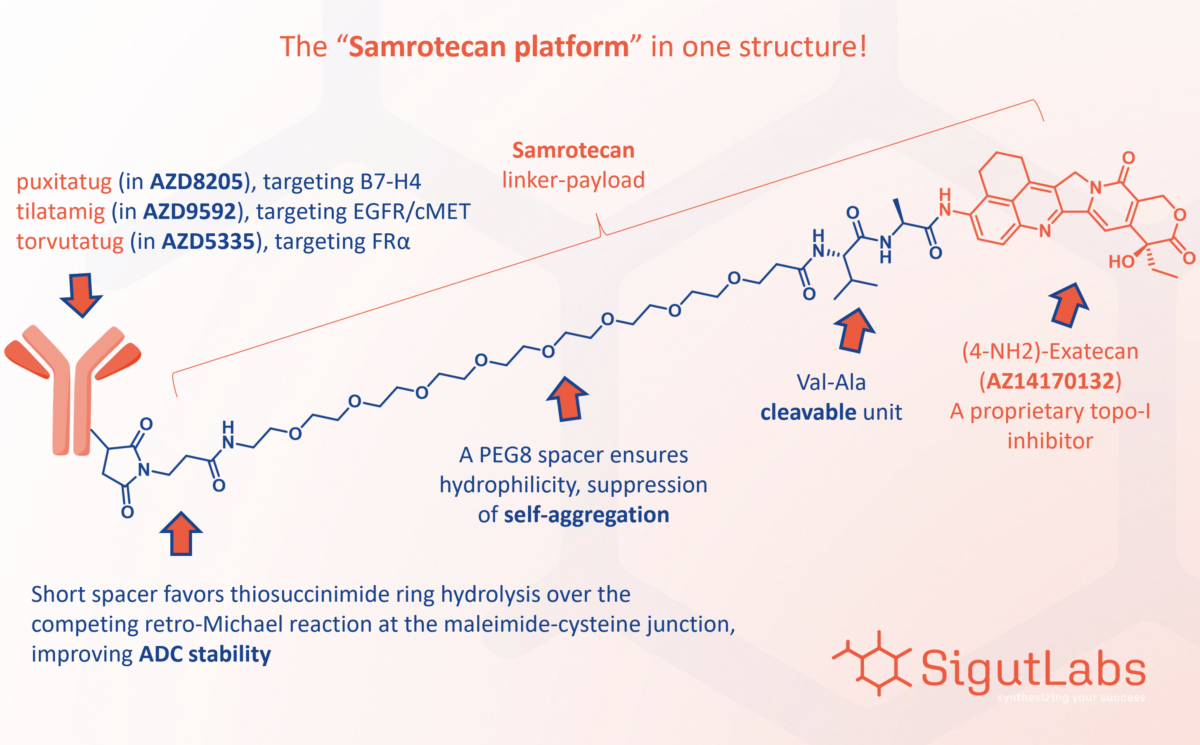
The three programmes are puxitatug samrotecan (AZD8205), targeting B7-H4; tilatamig samrotecan (AZD9592), targeting EGFR and cMET; and torvutatug samrotecan (AZD5335), targeting FRα. All three carry the same proprietary camptothecin-based topoisomerase I inhibitor, AZ14170132. Rather than designing a new payload for each target, AstraZeneca built one validated linker-payload chemistry and paired it with different antibodies.
Tilatamig samrotecan was discontinued in mid-2026 for unfavourable pharmacokinetics and pharmacodynamics, a reminder that a validated linker-payload reduces chemistry risk without removing biological risk. The platform logic is what interests us here.
Why platform thinking matters
Developing a new linker-payload is expensive in a way that is easy to underestimate. It is not only the synthesis. It is the stability studies, the biotransformation work, the analytical method development, the toxicology that attaches to a novel chemical entity, and the manufacturing route that eventually has to be transferred to a CDMO.
If that work is done once and the resulting module is reused, each subsequent programme starts from a known position. The antibody changes, the target biology changes, but the chemistry carrying the payload is already characterised. For an organisation running several ADC programmes in parallel, this is the difference between three chemistry campaigns and one.
The camptothecin class is particularly well suited to this treatment. Topoisomerase I payloads have a wide and well-mapped therapeutic window compared with the ultra-potent DNA binders, their release chemistry is understood, and the field has accumulated considerable experience with their behaviour in conjugates. We have written about the E-ring stability problem that any camptothecin payload has to contend with, and about Merck’s systematic exploration of exatecan linker-payloads, which approaches the same class from a different angle.
The linker study behind AZD8205
The optimisation work described by Kinneer and colleagues is where the chemistry gets specific, and it is worth following closely.
The team compared four linker variants built from two independent choices. The spacer was either a caproyl chain or a propionyl-PEG8 unit. The protease-cleavable element was either a Val-Ala dipeptide or a Gly-Gly-Phe-Gly tetrapeptide. All four combinations gave cysteine-conjugated ADCs at a DAR of approximately 8.
Four constructs, all active, all at the same DAR. The question was which one to take forward, and the answer did not come from potency data.
Conjugation stability decided it
A later biotransformation study by Huang and colleagues showed that the selected linker favours hydrolysis of the thiosuccinimide ring over the competing retro-Michael reaction at the maleimide-cysteine junction.
This distinction is central to cysteine-conjugated ADC design. When a maleimide reacts with a cysteine thiol, the resulting thiosuccinimide sits at a fork. It can undergo the retro-Michael reaction, releasing the linker-payload to be captured by serum albumin or other thiol-bearing proteins in circulation, which lowers the effective DAR and distributes payload where it does no good. Alternatively, the succinimide ring can hydrolyse to the ring-opened succinamic acid, which cannot undergo the reverse reaction at all. Once that hydrolysis has happened, the payload is locked on.
Which path dominates depends on the chemical environment around the maleimide, particularly on neighbouring electron-withdrawing groups and basic amines that can act as intramolecular catalysts for the hydrolysis. We explored the general principle in our article on strengthening maleimide-based ADCs, and the samrotecan work is a clear example of that principle being applied as a selection criterion in a clinical programme.
So the linker was chosen because of how it behaves at the conjugation site, not because of what it does to tumour cells in a potency assay. That is a more sophisticated basis for selection than it might first appear, because DAR stability in circulation determines how much payload actually arrives.
The three design decisions in summary
- The same payload core, AZ14170132, reused across three programmes rather than redesigned for each target.
- Peptide and PEG spacer chemistry tuned jointly for protease cleavage and for plasma stability, with four combinations evaluated systematically.
- Final linker selection driven by conjugation chemistry and biotransformation behaviour rather than by potency alone.
What this means for smaller programmes
Not every organisation runs three parallel ADC programmes, but the platform logic still applies in a reduced form.
If a linker-payload is designed from the start as a module, with a defined conjugation handle and well-characterised stability, it can be redeployed when the antibody changes, when a target disappoints, or when a second indication appears. The cost of that forward thinking is modest at the design stage and substantial later. Conversely, a linker-payload designed narrowly around one antibody and one set of conditions tends to need rework the moment anything shifts.
The practical implication is to invest in characterisation early. Knowing how your maleimide junction behaves, whether the ring hydrolyses, and what the catabolites actually are, is what allows a construct to be reused with confidence rather than re-validated from scratch.
How SigutLabs can help
We support exactly this kind of linker-payload platform work: designing chemistry robust enough to be reused across multiple ADC programmes, with the stability characteristics understood rather than assumed.
Our ADC linker service covers linker design and optimisation, synthesis from milligram to multi-gram scale, and CDMO-ready documentation for the handover. We also supply camptothecin-class payloads including exatecan mesylate through our e-shop. Our case study on novel linker design follows a programme from early screening through to a candidate in Phase 1.
If you are building or optimising a linker-payload platform, let’s connect.
References:

OUR CASE STUDY
Scale-up to accelerate drug discovery
Our experience helped overcome development hurdles for potential cancer & mental health drugs.
Read moreEmpowering neuro research with pro-N6pA
Sigut Labs scaled up pro-N6pA production, simplifying AMPylation research & boosting accessibility.
Read moreADC development leaps with new linkers
Novel linker design expedited ADC advancement, leading to promising lead compounds faster.
Read moreLincomycin derivative scale-up
Over 30 g of the desired product with exceptional purity was obtained through our optimized procedure.
Read morePurifying 350 kg of vitamin K2 oil
Our innovative scale-up technology helped to reduce the client’s purification process from days to hours.
Read moreOur services
What we excel in so you don’t have to
Custom synthesis
Providing for a custom synthesis of previously reported molecules using described synthetic procedures.
View more
Contract research
Developing novel synthetic routes to provide undescribed compounds in organic, bioorganic, and medicinal chemistry.
View more






Our Experts


Partners & distributors