Inside Merck’s New Exatecan Linker-Payload Chemistry: Two Papers, One Clear Lesson
Two new papers from Merck, both recently published in the Journal of Medicinal Chemistry, offer a rare and detailed look at how linker-payload chemistry drives ADC performance — from early payload design all the way through in vivo efficacy.
Both studies start from exatecan and build new linker-payloads around it. Rather than chasing an entirely new payload mechanism, the teams systematically tuned the attachment point, linker polarity, branching, and the chemical environment around the maleimide. The goal in both cases: better DAR retention, lower aggregation, and improved pharmacokinetics.
Paper One: Diol-Containing Exatecan-Amide Payloads
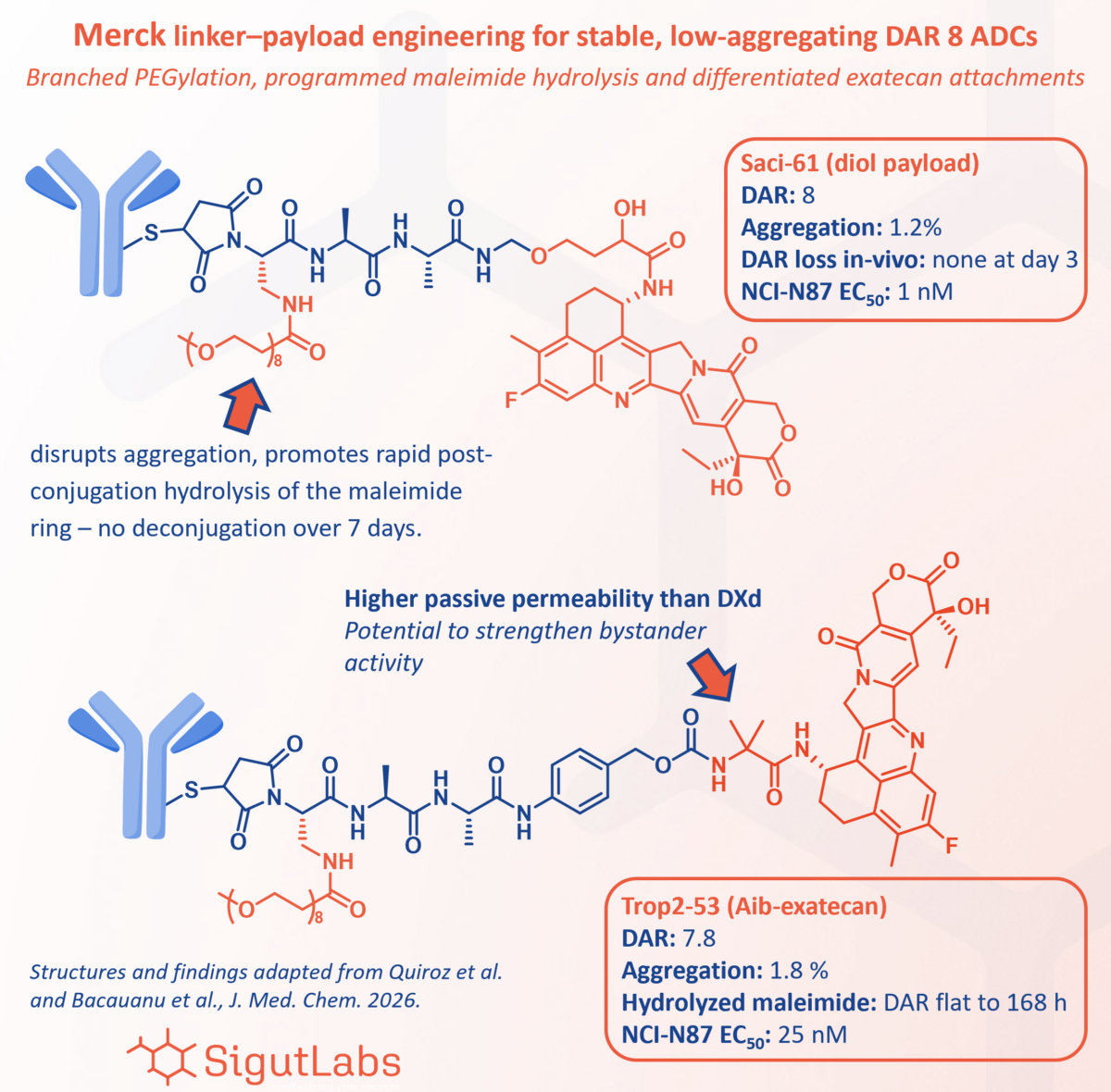
The first paper, led by Ryan V. Quiroz, introduces a new class of diol-containing exatecan-amide payloads. The extra alcohol group provides a second attachment point for a hemiaminal linker, while the original alpha-hydroxyl group — important for potency, as it is in DXd — is kept intact.
The lead construct pairs a butanediol exatecan-amide payload with an Ala-Ala protease-cleavable linker and a hemiaminal connection. A branched PEG8-amide group is positioned right next to the maleimide.
This branched group does double duty: it helps prevent aggregation, and it draws in local water molecules to speed up post-conjugation hydrolysis of the maleimide ring. Once the ring is open, the conjugate becomes resistant to retro-Michael deconjugation. The result is a low-aggregating DAR8 ADC with essentially no DAR loss, strong pharmacokinetics, and clear tumor regression in vivo.
Paper Two: Redesigning the Payload-Linker Connection
The second paper, led by Vlad Bacauanu (with W. Michael Seganish as senior author on both papers), takes a different approach and redesigns the payload-linker connection itself. The team developed amine-bearing camptothecin analogues that could be attached through classic protease-cleavable PABC linkers.
Their lead payload, an alpha-aminoisobutyric acid-derived exatecan (Aib-exatecan), matched DXd’s potency while offering better passive permeability. Because it lacks an electron-withdrawing group next to the amine, it also produced far more stable PABC linkages than related difluoromethyl analogues, which were prone to premature cleavage.
On the linker side, the team found that simply adding a hydrophilic group wasn’t enough — placement mattered more. Branching a PEG unit close to the maleimide, rather than near the PABC group, produced the most stable conjugates, with rapid maleimide hydrolysis and minimal deconjugation. These Aib-exatecan constructs performed well as high-DAR, low-aggregating ADCs against both ROR1 and Trop2 targets.
The Common Thread
Together, the two papers make the same point from different angles: linker optimization isn’t simply a matter of adding hydrophilicity somewhere in the structure. Polarity, branching, spatial placement, electronics, protease accessibility, and maleimide reactivity all have to be balanced together to achieve a stable, high-DAR, low-aggregating ADC.
SigutLabs’ Perspective
This is exactly the kind of chemistry we work on daily at SigutLabs: custom linker and linker-payload design for ADC programs, including the fine-grained structural decisions — branching position, spacer chemistry, maleimide environment — that these papers show can make or break conjugate performance.
If small structural changes like these are shaping the next generation of ADCs, we’d love to help you explore them for your own program. Contact us — let’s connect.
References:
- Bacauanu, V., Chen, S. J., Lang, S. B., Morales, C. L., Zepeda, N., Charati, M., … & Seganish, W. M. (2026). Discovery of Novel N-Linked Camptothecin Linker-Payloads to Access Antibody–Drug Conjugates with High Target-Mediated In Vivo Efficacy. Journal of Medicinal Chemistry, 69(9), 9952-9976.
- Quiroz, R. V., Lang, S. B., Johnson, R. E., Zepeda, N., Bacauanu, V., Morales, C. L., … & Seganish, W. M. (2026). Design of Novel Exatecan-Amide Linker-Payloads for the Development of Stable, Low-Aggregating, and Highly Efficacious Antibody-Drug Conjugates. Journal of Medicinal Chemistry, 69(9), 9928-9951.

OUR CASE STUDY
Scale-up to accelerate drug discovery
Our experience helped overcome development hurdles for potential cancer & mental health drugs.
Read moreEmpowering neuro research with pro-N6pA
Sigut Labs scaled up pro-N6pA production, simplifying AMPylation research & boosting accessibility.
Read moreADC development leaps with new linkers
Novel linker design expedited ADC advancement, leading to promising lead compounds faster.
Read moreLincomycin derivative scale-up
Over 30 g of the desired product with exceptional purity was obtained through our optimized procedure.
Read morePurifying 350 kg of vitamin K2 oil
Our innovative scale-up technology helped to reduce the client’s purification process from days to hours.
Read moreOur services
What we excel in so you don’t have to
Custom synthesis
Providing for a custom synthesis of previously reported molecules using described synthetic procedures.
View more
Contract research
Developing novel synthetic routes to provide undescribed compounds in organic, bioorganic, and medicinal chemistry.
View more





Our Experts


Partners & distributors