Dibromopyridazinediones: Disulfide Rebridging for Homogeneous DAR 4 ADCs
Most cysteine-based antibody-drug conjugates are built by breaking something first. The classical route reduces the four interchain disulfides of an IgG1 and caps the resulting free thiols, usually with a maleimide. It works, it is operationally simple, and it is behind several approved drugs. But two things are lost along the way, and both of them matter.
The first is structural. The covalent bridges that held the heavy and light chains together are gone, replaced by nothing. What holds the antibody together afterwards is non-covalent interaction alone. The second is chemical. The thiosuccinimide formed by Michael addition can undergo the reverse reaction in circulation, handing the payload to serum albumin before the conjugate reaches the tumour, a problem we examined in detail in our article on improving maleimide ADC stability.
Disulfide rebridging addresses both at once.
The principle
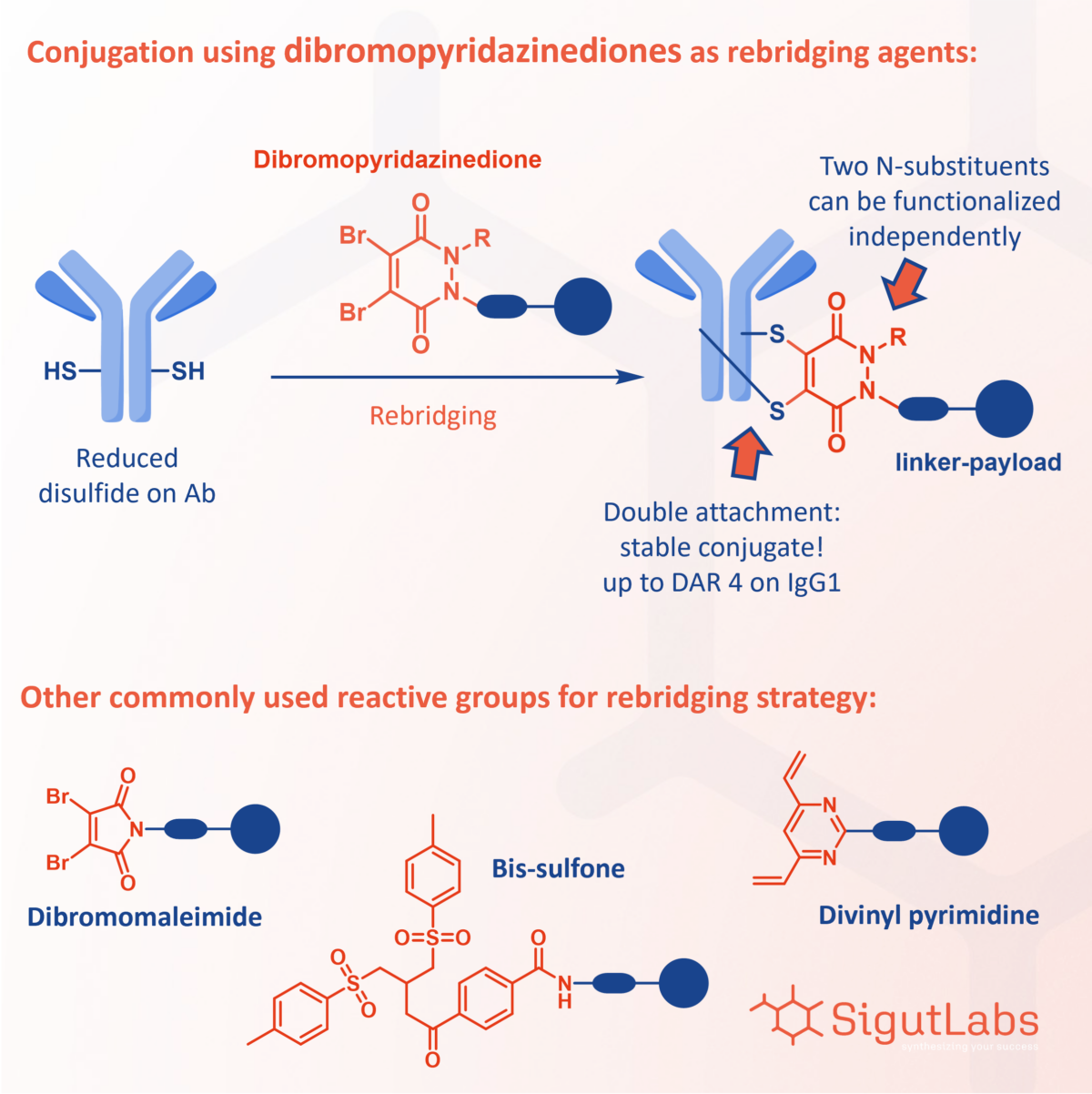
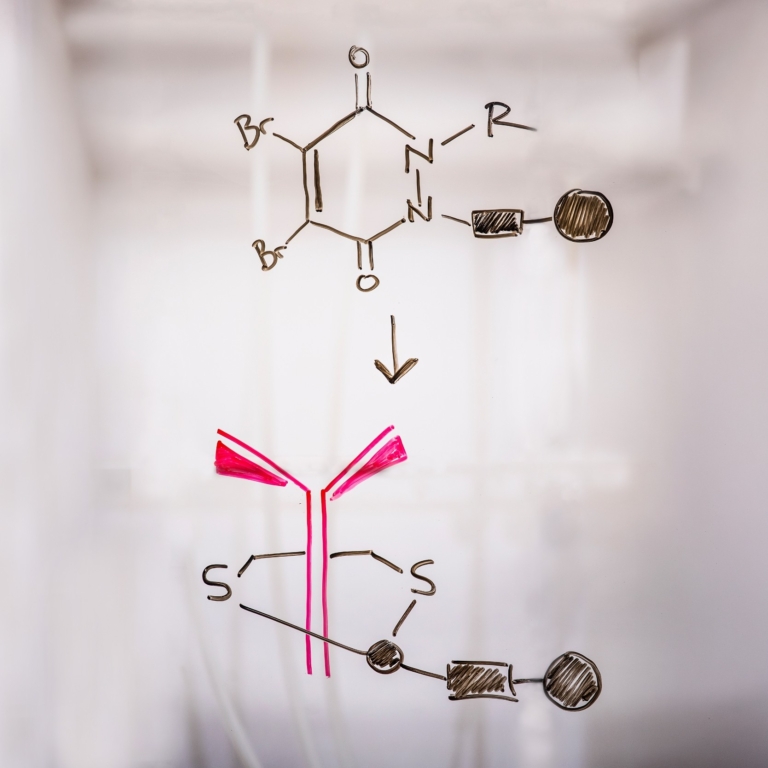
A rebridging reagent is a bifunctional electrophile. After the interchain disulfide is reduced, the reagent reacts with both thiols released from that same disulfide and inserts itself between them, replacing the natural S-S bond with a synthetic bridge that also carries the attachment handle for the payload.
The original disulfide is not restored. What is restored is the covalent connectivity between the chains, and with it a native-like architecture in which the heavy and light chains remain formally linked. In an IgG1, the four interchain disulfides give four bridges, which means a homogeneous DAR of 4 without any protein engineering, without an enzyme, and without unnatural amino acids. The antibody is used exactly as produced.
That is an unusual combination. Most routes to homogeneous DAR require modifying the antibody itself, whether through engineered cysteines, glycan remodelling or incorporation of a non-canonical residue. Rebridging gets there with chemistry alone.
Why we favour dibromopyridazinediones
Several reagent classes perform disulfide rebridging, including bis-sulfone reagents, dibromomaleimides and various bridging bis-electrophiles. Among them, dibromopyridazinediones (diBrPDs) are the ones we find most compelling, for four reasons.
- Cysteine selectivity. The two bromides are displaced by the two thiols released from a single reduced disulfide, and the geometry of the pyridazinedione ring favours bridging the correct pair rather than reacting across different disulfides.
- Pyridazinedione conjugates have been reported to be stable for seven days under plasma-mimicking conditions, for eight months at 4 °C in PBS, and also under acidic conditions, as described by Maruani and co-workers.
- Optimised diBrPD reagents have delivered site-selectively modified native trastuzumab with over 90% homogeneity and without disulfide scrambling, work reported by Bahou and colleagues.
- Two handles rather than one. This is the property we find most interesting, and it deserves its own section.
Two independent handles on one bridge
The pyridazinedione ring carries two nitrogen substituents that can be functionalised independently of one another. Where a maleimide gives a single attachment point per conjugation site, a diBrPD gives two.
The practical consequence is a dual-click architecture. One arm can carry the cytotoxic payload while the other carries something entirely different: a second payload with a complementary mechanism, an imaging or diagnostic probe, a PEG or other PK-modifying group, or a purification handle used during manufacture and then retained or removed.
This turns a conjugation reagent into a modular scaffold. It is a different route to the kind of multi-functionality we discussed in our article on dual-payload ADCs, achieved at the conjugation site rather than through a branched linker, and it does so while keeping DAR at a well-controlled 4.
The honest caveat
This chemistry is not a free lunch, and the reason it remains less widely used than its properties would justify is entirely synthetic.
Making functionalised dibromopyridazinediones is genuinely difficult. The core chemistry is sensitive, the bromination step must be controlled carefully, and the differentiated functionalisation of the two ring nitrogens requires an orthogonal protecting-group strategy that has to survive everything downstream. The reagents with built-in reducing capacity, which give the cleanest conjugations because they handle disulfide reduction and rebridging in one operation, are the hardest of all to make and do not store well.
For many groups, that is where the idea stops. The conjugation chemistry is attractive, the reagent is not commercially available in the form the programme needs, and the synthesis is beyond what a biology-focused team wants to take on. This is a case where the bottleneck is not the concept but access to material.
Where it fits in a programme
Disulfide rebridging is worth serious consideration when a programme needs homogeneous DAR 4 on an antibody that cannot or should not be engineered, when the stability problems of maleimide conjugation are a known liability, or when the construct needs to carry two different functions from a single attachment site. It is less relevant where very high DAR is required, since the four interchain disulfides set a natural ceiling, or where an established site-specific platform is already validated within the organisation.
For programmes evaluating conjugation strategy more broadly, our articles on 2-methyl(sulfonyl)pyrimidine warheads and on strategies for controlling DAR cover the neighbouring options.
How SigutLabs can help
We have practical, hands-on experience with the synthesis of dibromopyridazinedione rebridging reagents and their linker-payload derivatives, including differentially functionalised constructs for dual-click applications. If your programme needs a homogeneous DAR 4 conjugate on a native antibody, or a bridge carrying two different functions, this is chemistry we can make for you.
Our ADC linker service covers design, synthesis and purification, and we deliver material ready for conjugation. For a sense of how this works over the life of a programme, our case study on novel linker design describes a collaboration that ran from early linker screening through to a candidate in Phase 1.
If rebridging chemistry is on your roadmap, let’s connect.
References:
- Maruani, A. et al. *Nature Communications* 2015, 6, 6645. DOI: 10.1038/ncomms7645
- Bahou, C. et al. *Organic & Biomolecular Chemistry* 2018, 16, 1359. DOI: 10.1039/C7OB03138F

OUR CASE STUDY
Scale-up to accelerate drug discovery
Our experience helped overcome development hurdles for potential cancer & mental health drugs.
Read moreEmpowering neuro research with pro-N6pA
Sigut Labs scaled up pro-N6pA production, simplifying AMPylation research & boosting accessibility.
Read moreADC development leaps with new linkers
Novel linker design expedited ADC advancement, leading to promising lead compounds faster.
Read moreLincomycin derivative scale-up
Over 30 g of the desired product with exceptional purity was obtained through our optimized procedure.
Read morePurifying 350 kg of vitamin K2 oil
Our innovative scale-up technology helped to reduce the client’s purification process from days to hours.
Read moreOur services
What we excel in so you don’t have to
Custom synthesis
Providing for a custom synthesis of previously reported molecules using described synthetic procedures.
View more
Contract research
Developing novel synthetic routes to provide undescribed compounds in organic, bioorganic, and medicinal chemistry.
View more






Our Experts


Partners & distributors