pH-Sensitive Linkers in ADCs: Hydrazones, Cis-Aconityl and Acetals
Every cleavable ADC linker is an attempt to exploit a difference between the bloodstream and the inside of a target cell. Protease-cleavable linkers use enzyme distribution. Disulfides use the glutathione gradient. pH-sensitive linkers use the simplest difference of all: acidity.
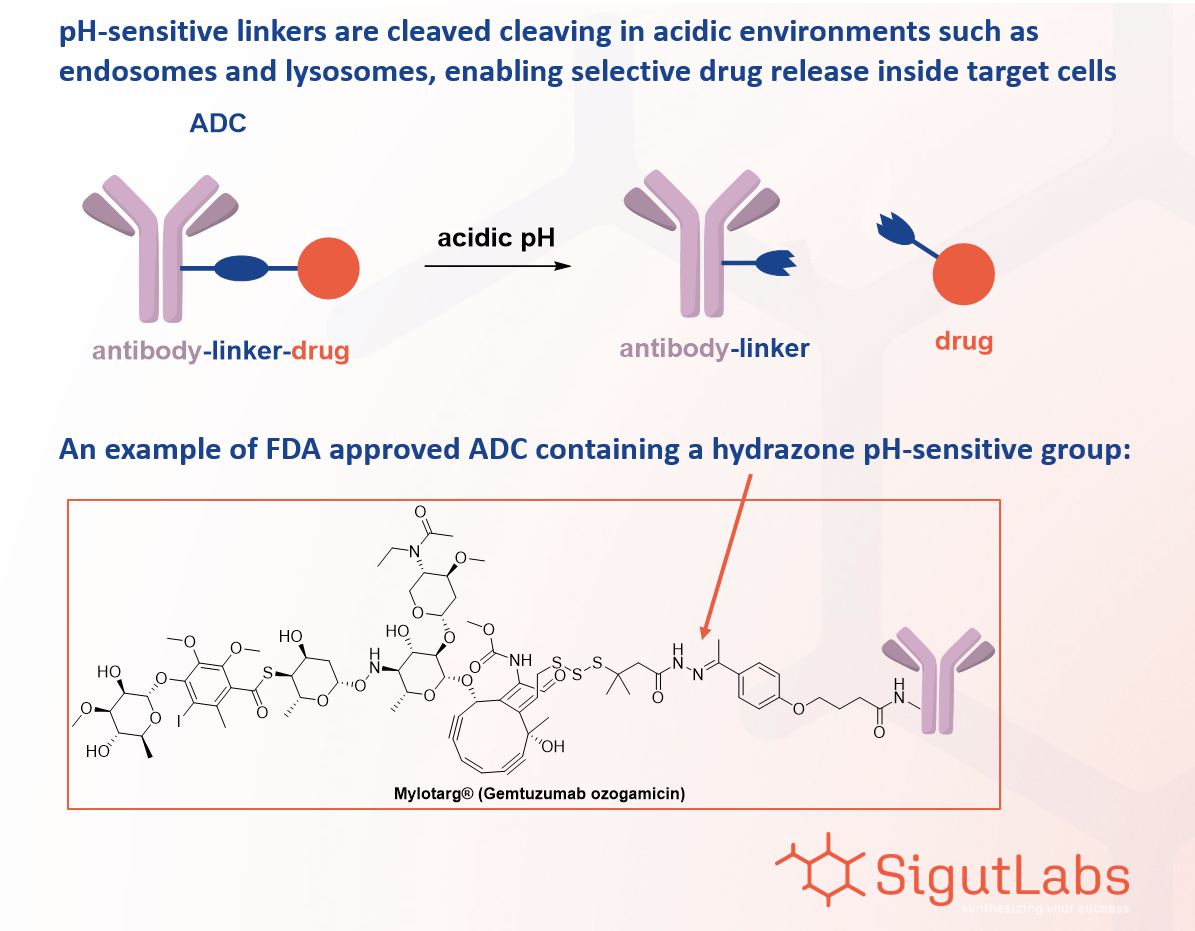
Blood sits at pH 7.4. After an ADC binds its antigen and is internalised, it passes into early endosomes at roughly pH 6.0 to 6.5, then into late endosomes and lysosomes where the pH falls to between 4.5 and 5.5. A bond that is stable at physiological pH but hydrolyses over minutes to hours in that acidic compartment will release its payload at the right place, without requiring any enzyme to be present at all.
The chemistry that got ADCs started
Acid-labile linkers were among the first cleavable chemistries used in clinically approved ADCs, and they are still in approved products today. Gemtuzumab ozogamicin and inotuzumab ozogamicin both attach their calicheamicin payload through an acyl hydrazone, which hydrolyses in the acidic endosomal and lysosomal environment to release the active drug.
That history is worth remembering, because pH-sensitive chemistry is sometimes treated as a first-generation approach that has been superseded. It has not. It has been refined, and the refinements are chemically interesting.
Three linker classes, three different trade-offs
Hydrazone linkers are formed by condensation of a hydrazide with a ketone or aldehyde on the payload. They are straightforward to install, and the cleavage mechanism is well understood: protonation of the hydrazone nitrogen in the acidic compartment accelerates hydrolysis back to the carbonyl and hydrazide. Their limitation is the one that shaped the next two decades of linker development. Hydrolysis is not switched off at pH 7.4, merely slower, so a hydrazone-linked ADC loses payload gradually in circulation. The electronic and steric environment around the hydrazone can shift that rate considerably, and aryl hydrazones behave differently from aliphatic ones, but the underlying sensitivity remains.
Cis-aconityl linkers take a different route. An amine on the payload is acylated with cis-aconitic anhydride, leaving a free carboxylate positioned close to the resulting amide. At low pH the carboxylic acid is protonated and participates in intramolecular catalysis, attacking the adjacent amide and accelerating its cleavage. At neutral pH the carboxylate is deprotonated and no such assistance occurs. The result is better plasma stability than a typical hydrazone, with the acid-triggered release preserved. The approach has been explored extensively with anthracycline payloads, where the amine handle is readily available.
Acetal and ketal linkers offer the finest control. The hydrolysis rate of an acetal depends strongly on the substituents around it, and that dependence is systematic enough to be used as a design parameter. Moving from a simple dialkyl acetal through cyclic variants to electron-rich or sterically hindered systems shifts the half-life across orders of magnitude. For a programme that knows how fast it needs release to occur, this tunability is valuable, and the modularity makes acetals convenient points at which to attach hydrophilic units or self-immolative spacers.
The bystander argument
There is a second reason acid-labile chemistry retains its place, and it concerns tumours rather than cells.
Solid tumours are frequently acidic in the extracellular space, a consequence of altered glycolytic metabolism and poor perfusion. A pH-sensitive linker can therefore release payload not only inside the target cell but also, to some degree, in the acidic tumour microenvironment. Because the released drug is the free, often membrane-permeable payload, it can diffuse into neighbouring cells that do not express the target antigen at all.
For heterogeneous tumours, or for targets with poor internalisation, that bystander effect can be the difference between activity and none. We discussed the same principle from the opposite direction in our article on ADC resistance mechanisms, where heterogeneous antigen expression is one of the main routes by which tumours escape.
The design problem in one sentence
The entire difficulty of pH-sensitive linker design is that stability at pH 7.4 and lability at pH 5.0 are governed by the same chemistry.
Anything that accelerates cleavage in the lysosome also accelerates it, to some extent, in the blood. The art lies in finding structures where the rate difference between the two environments is as large as possible, rather than simply making the bond more or less labile overall. Intramolecular catalysis, as in the cis-aconityl system, is one way to widen that gap, because the catalytic group is only active when protonated. Careful electronic tuning of acetals is another.
This is also why these linkers need real characterisation work. Measured hydrolysis half-lives at several pH values, stability in plasma from the relevant species, and identification of the actual released species all have to be established, since a linker that is well behaved in buffer can behave quite differently in serum.
Where they fit today
pH-sensitive linkers are a strong choice when the payload has a convenient carbonyl or amine handle, when the programme wants a bystander effect, or when enzyme-dependent release is unattractive because the relevant protease activity is variable or because off-target cleavage is a known liability. Val-Cit, the most common enzymatically cleavable linker, is a well-documented case: it is also a substrate for circulating neutrophil elastase, which releases payload in the bloodstream rather than in the tumour.
They are a weaker choice when the payload is extremely potent and the therapeutic window narrow, where slow circulating hydrolysis becomes a toxicity problem, or where regulatory and analytical simplicity favour a non-cleavable design.
If you are weighing the options across the whole linker toolbox, our overview of what makes a good linker for antibody-drug conjugates is a useful starting point, and our article on traceless linkers covers the release-chemistry side in more depth.
How SigutLabs can help
Acid-labile linkers demand careful synthetic planning, because the motif that gives the molecule its function is also the motif most likely to be destroyed during the synthesis and purification of the linker-payload itself. Choosing the order of operations, the protecting-group strategy and the purification conditions is most of the work.
At SigutLabs we design and synthesise custom ADC linkers and linker-payloads, including hydrazone, cis-aconityl and acetal-based acid-labile constructs, with stability and cleavage profiles matched to what the programme needs. We also supply ADC payloads such as calicheamicin and other ADC building blocks through our e-shop.
If you need a pH-sensitive linker built to a specific release profile, let’s connect.

OUR CASE STUDY
Scale-up to accelerate drug discovery
Our experience helped overcome development hurdles for potential cancer & mental health drugs.
Read moreEmpowering neuro research with pro-N6pA
Sigut Labs scaled up pro-N6pA production, simplifying AMPylation research & boosting accessibility.
Read moreADC development leaps with new linkers
Novel linker design expedited ADC advancement, leading to promising lead compounds faster.
Read moreLincomycin derivative scale-up
Over 30 g of the desired product with exceptional purity was obtained through our optimized procedure.
Read morePurifying 350 kg of vitamin K2 oil
Our innovative scale-up technology helped to reduce the client’s purification process from days to hours.
Read moreOur services
What we excel in so you don’t have to
Custom synthesis
Providing for a custom synthesis of previously reported molecules using described synthetic procedures.
View more
Contract research
Developing novel synthetic routes to provide undescribed compounds in organic, bioorganic, and medicinal chemistry.
View more







Our Experts


Partners & distributors