Disulfide Linkers in ADCs: Tuning Stability Against Intracellular Release
Antibody-drug conjugates depend on a linker that behaves in two contradictory ways: completely stable for the days an ADC spends in circulation, then rapidly cleaved once it reaches the inside of a target cell. Among the cleavable chemistries available, disulfide linkers solve this with an unusually direct mechanism, and with a degree of tunability that few other triggers can match.
The gradient the chemistry exploits
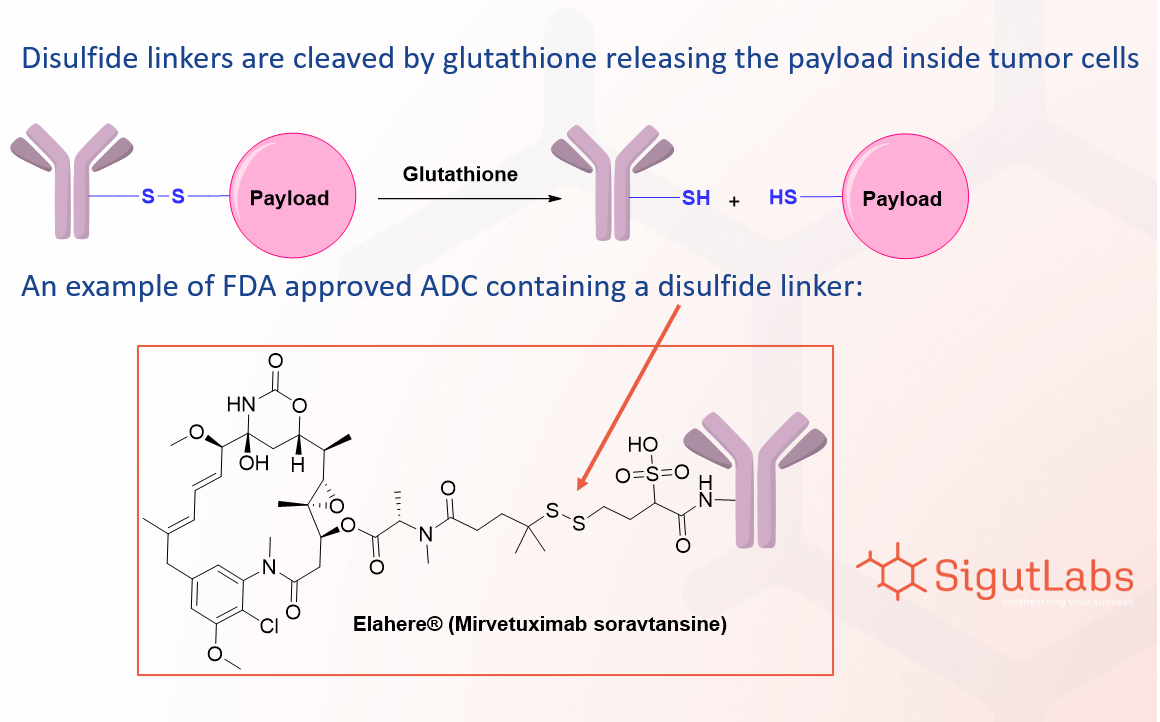
A disulfide linker contains a single -S-S- bond placed between the antibody attachment point and the payload. That bond is reduced by thiols, and the concentration of the relevant thiol differs enormously between the two environments an ADC encounters.
Extracellular glutathione sits in the low micromolar range. Intracellular glutathione is typically in the millimolar range, roughly a thousandfold higher, and many tumour cells maintain levels at the upper end of that range as part of their response to oxidative stress. A bond that survives the first environment and is cleaved in the second is, in principle, an excellent release trigger.
What makes the design attractive in practice is that the cleavage is traceless. Reduction gives a free thiol on the payload side, and if the payload itself carries a thiol, the native drug is released directly with no residual linker fragment. Where the payload has no thiol, a self-immolative spacer such as a disulfide-PABC construct performs the same function, releasing the unmodified drug after reduction triggers the elimination cascade. We covered this general principle in our article on self-immolative linkers.
Steric hindrance is the design lever
The weakness of a simple dialkyl disulfide is that the circulation is not actually thiol-free. Serum albumin carries a free cysteine, and residual plasma thiols are enough to cleave an unprotected disulfide slowly over the days an ADC circulates. The result is premature payload release and the systemic toxicity that follows.
The classical fix is steric. Placing substituents on the carbon atoms adjacent to the sulfur atoms shields the S-S bond from attack. Each methyl group added near the disulfide slows reduction measurably, and the progression from unsubstituted to mono-, di- and tetra-substituted disulfides gives a tunable series rather than a binary choice. Bulky tertiary thiols and hindered aryl systems extend the same principle further.
This is the useful part of disulfide chemistry: stability is a dial, not a fixed property. A linker can be matched to the pharmacokinetics the programme needs, slowing cleavage for a long-circulating construct or accelerating it where rapid intracellular release matters more than plasma half-life. Few other cleavable chemistries offer such a straightforward structure-stability relationship.
What makes disulfides worth considering
Summarising the practical advantages:
- Bioreductive activation. Release is driven by a genuine intracellular-versus-extracellular difference, rather than by an enzyme whose distribution may be less predictable.
- Steric hindrance around the S-S bond allows plasma stability and release rate to be adjusted systematically during optimisation.
- Traceless release. The native payload is liberated, with no linker remnant to alter potency or membrane permeability.
- Architectural flexibility. The chemistry is compatible with cysteine conjugation on the antibody and with thiol-containing payloads, and it can be combined with PEG, sarcosine or other hydrophilicity-modulating units.
- Bystander potential. Because the released drug is the unmodified, often membrane-permeable payload, disulfide linkers can support killing of neighbouring antigen-negative cells in heterogeneous tumours.
Where they fit, and where they do not
Disulfide linkers are the right choice when the tumour biology actually provides the reductive environment the mechanism assumes, and when the payload benefits from rapid and complete intracellular release. They are also valuable when the payload chemistry offers a convenient thiol handle, which makes the conjugation straightforward.
They are a poorer fit when the programme needs extremely long circulation with near-zero payload loss, where non-cleavable or enzymatically cleavable chemistries may be more predictable. They can also be difficult when the payload is highly potent and the therapeutic window narrow, since even a small fraction of premature reduction translates into measurable toxicity.
It is worth noting that disulfides are not the only glutathione-responsive option. In our comparison of azobenzene and disulfide GSH-cleavable triggers we looked at an azobenzene-based system whose reductive cleavage can be tuned through the substitution pattern of the aromatic ring, giving a different handle on the same biological gradient.
Synthesis is where the difficulty sits
Designing a hindered disulfide on paper is easy. Making it reproducibly is less so.
Unsymmetrical disulfides have to be assembled selectively, usually through an activated intermediate such as a pyridyl disulfide or a thiosulfonate, and the reaction has to be controlled to avoid scrambling into the two symmetrical products. Increasing steric hindrance, which is the point of the exercise, also slows the desired coupling, so the conditions that give clean conversion for an unhindered substrate often fail for a tetra-substituted one.
Purification brings its own problems. Disulfides are sensitive to reduction and to disproportionation during chromatography and storage, free thiol impurities are difficult to remove and will degrade the product over time, and analytical methods have to be chosen so that the disulfide survives the analysis itself.
When the disulfide is carried into a full linker-payload, these issues compound with everything else the molecule has to tolerate: a self-immolative spacer, a conjugation handle, a hydrophilic unit, and a payload that may itself be unstable. Sequence of operations and choice of protecting groups become the decisive factors, not the individual reactions.
How SigutLabs can help
Disulfide linkers reward careful chemistry, and they punish a route that was not designed with their sensitivity in mind. At SigutLabs we have hands-on experience synthesising hindered disulfide linkers and their linker-payload derivatives, including unsymmetrical couplings, self-immolative disulfide-PABC constructs and hydrophilicity-modified variants. Our chemists work on custom ADC linker design and synthesis from route scouting through to purified, vial-ready material, and we can also support the work as a broader custom synthesis project.
If you need a disulfide linker tuned to a specific stability profile, or a linker-payload built around a thiol-bearing payload, let’s connect and discuss what the molecule has to do.

OUR CASE STUDY
Scale-up to accelerate drug discovery
Our experience helped overcome development hurdles for potential cancer & mental health drugs.
Read moreEmpowering neuro research with pro-N6pA
Sigut Labs scaled up pro-N6pA production, simplifying AMPylation research & boosting accessibility.
Read moreADC development leaps with new linkers
Novel linker design expedited ADC advancement, leading to promising lead compounds faster.
Read moreLincomycin derivative scale-up
Over 30 g of the desired product with exceptional purity was obtained through our optimized procedure.
Read morePurifying 350 kg of vitamin K2 oil
Our innovative scale-up technology helped to reduce the client’s purification process from days to hours.
Read moreOur services
What we excel in so you don’t have to
Custom synthesis
Providing for a custom synthesis of previously reported molecules using described synthetic procedures.
View more
Contract research
Developing novel synthetic routes to provide undescribed compounds in organic, bioorganic, and medicinal chemistry.
View more





Our Experts


Partners & distributors