The First Approved PROTAC: What Vepdegestrant Means for Targeted Protein Degradation
Targeted protein degradation has been one of the most discussed concepts in drug discovery for years. With the FDA approval of vepdegestrant — developed by Arvinas and Pfizer — it has stopped being a concept. As the first approved PROTAC therapy, indicated for adults with ER+/HER2-, ESR1-mutated advanced breast cancer, vepdegestrant confirms that degraders are now a clinical reality, not just a promising idea on the bench.
So why has the field been so excited about this class of molecule?
A Fundamentally Different Strategy
Most targeted therapies work by inhibition. A kinase inhibitor, for example, binds a protein’s active site and blocks its function for as long as the drug remains bound. PROTACs take a different approach entirely: instead of inhibiting a protein, they eliminate it.
By tagging the target protein for destruction, a PROTAC removes it from the cell altogether. This matters clinically, because it can sidestep resistance mechanisms that defeat inhibitors — resistance that arises through mutations at the binding site or through sheer overexpression of the target protein. You cannot mutate your way around a protein that is no longer there.
The Anatomy of a Degrader
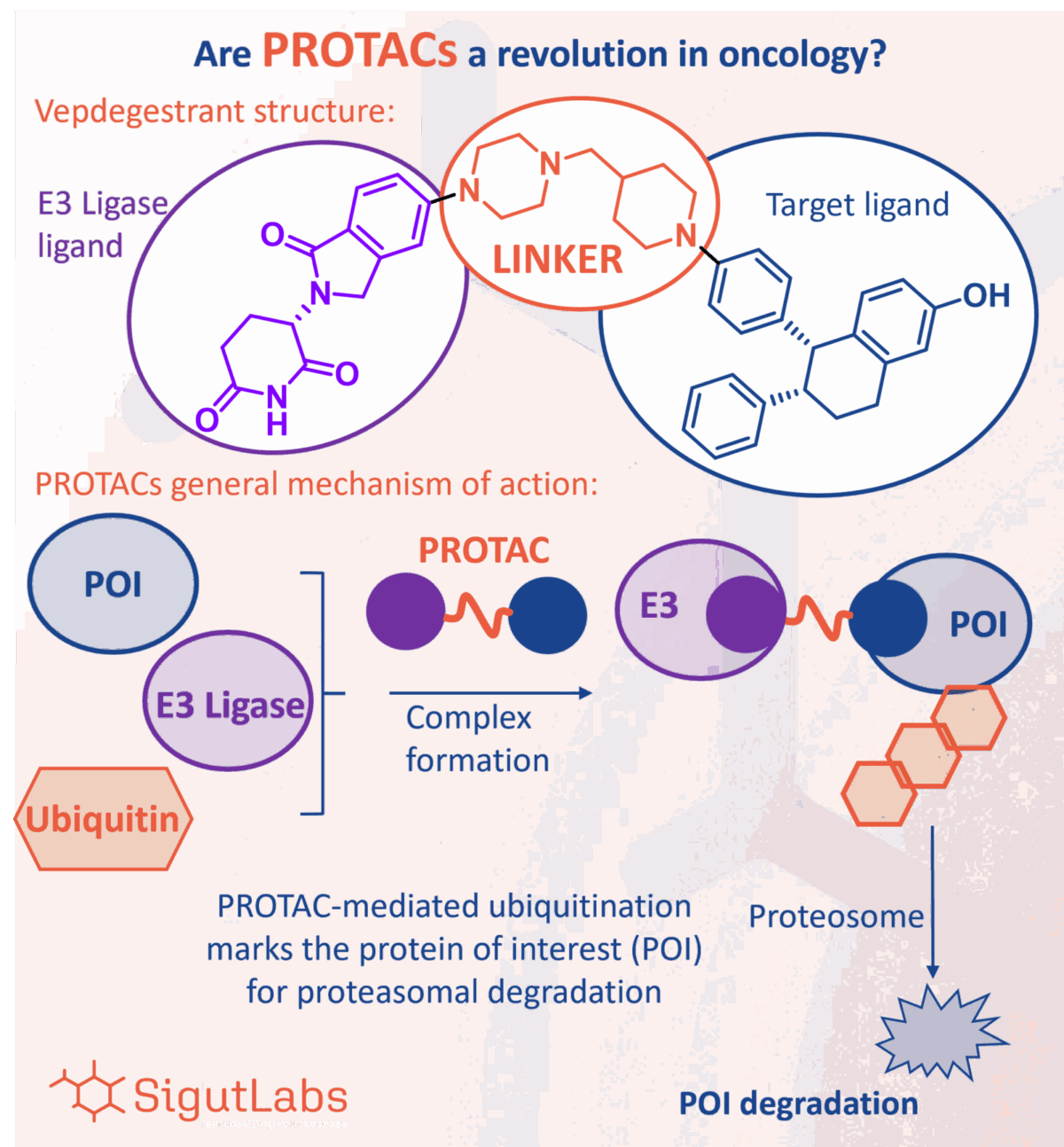
A PROTAC is a heterobifunctional molecule built from three parts:
- A target ligand that binds the protein of interest
- An E3 ligase ligand that recruits an E3 ubiquitin ligase, such as CRBN or VHL
- A linker that chemically connects the two
The two binding ligands are the intuitive components. The linker is where much of the real difficulty — and the real chemistry — lives.
Why the Linker Decides Everything
It is tempting to think of the linker as a passive tether. In practice, it is often the single factor that determines whether a PROTAC works at all.
For degradation to occur, the target protein and the E3 ligase must be brought into a precise spatial arrangement — the ternary complex. The linker’s length, flexibility, and chemical composition directly govern whether that complex can form productively. Small changes can have outsized effects: modest linker modifications can dramatically shift potency, selectivity, cell permeability, and overall drug-like properties.
This is why PROTAC development is so chemistry-intensive. The binding ligands set the targets, but the linker tunes the molecule into something that actually functions inside a cell.
How PROTACs Differ from ADCs
PROTACs and antibody-drug conjugates both rely on molecular specificity, but they operate very differently. ADCs are large constructs that deliver a cytotoxic payload to a cell. PROTACs are typically small molecules that enter cells directly and act intracellularly — without any cytotoxic payload at all.
Instead of killing the cell with a toxin, a PROTAC hijacks the cell’s own waste-disposal system, the ubiquitin-proteasome pathway, to selectively remove a disease-causing protein. The cell does the work; the PROTAC simply directs it.
A Medicinal Chemistry Evolution
The path to vepdegestrant is itself a compelling story of chemical optimisation:
- Early PROTACs were peptide-based and struggled with cell permeability and poor drug-like properties.
- The shift to fully small-molecule PROTACs transformed the picture, improving stability, permeability, and oral bioavailability — and making molecules like vepdegestrant possible.
- Today, the approach is expanding beyond conventional protein targets toward RNA targets and previously “undruggable” transcription factors.
Each of these steps was driven by chemistry, and the frontier continues to move in the same way.
The Broader Picture
The approval of vepdegestrant is a genuine inflection point. It validates an entire modality and opens the door to applying targeted degradation against targets that inhibition could never reach. Targeted protein degradation is rapidly becoming one of the most exciting areas in drug discovery — and at every stage, chemistry remains at the centre of its progress.
How SigutLabs Can Help
At SigutLabs, we specialise in custom small-molecule synthesis and medicinal chemistry support. As targeted protein degradation grows, we are particularly engaged by the chemistry challenges behind PROTAC design:
- Linker design and optimisation for productive ternary complex formation
- Synthesis of novel degrader building blocks, including E3 ligase ligands
- Medicinal chemistry support to improve permeability, selectivity, and drug-like properties
If your team is exploring next-generation degrader concepts, we are always interested in collaborating.

OUR CASE STUDY
Scale-up to accelerate drug discovery
Our experience helped overcome development hurdles for potential cancer & mental health drugs.
Read moreEmpowering neuro research with pro-N6pA
Sigut Labs scaled up pro-N6pA production, simplifying AMPylation research & boosting accessibility.
Read moreADC development leaps with new linkers
Novel linker design expedited ADC advancement, leading to promising lead compounds faster.
Read moreLincomycin derivative scale-up
Over 30 g of the desired product with exceptional purity was obtained through our optimized procedure.
Read morePurifying 350 kg of vitamin K2 oil
Our innovative scale-up technology helped to reduce the client’s purification process from days to hours.
Read moreOur services
What we excel in so you don’t have to
Custom synthesis
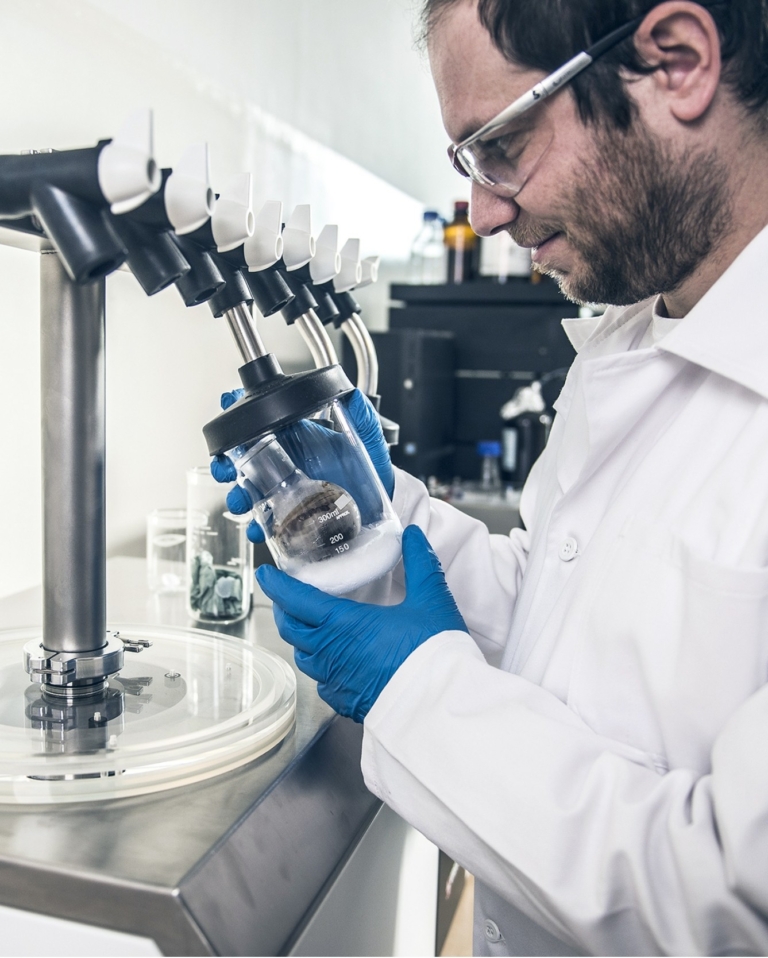
Providing for a custom synthesis of previously reported molecules using described synthetic procedures.
View more
Contract research
Developing novel synthetic routes to provide undescribed compounds in organic, bioorganic, and medicinal chemistry.
View more





Our Experts


Partners & distributors