From Tesirine to CS5001: How Chemistry Is Redeeming PBD Dimer ADCs
Pyrrolobenzodiazepine (PBD) dimers are among the most potent payloads available to antibody-drug conjugate developers. By cross-linking the minor groove of DNA, they achieve cytotoxicity in the picomolar range. But raw potency has never been the hard part. The decade-long challenge has been translating that in vitro power into a molecule that is safe enough to dose in patients — and that translation is fundamentally a medicinal chemistry problem.
The contrast between the first generation of PBD ADCs and the emerging CS5001 programme is one of the clearest illustrations of why.
The First Generation: The Tesirine Construct
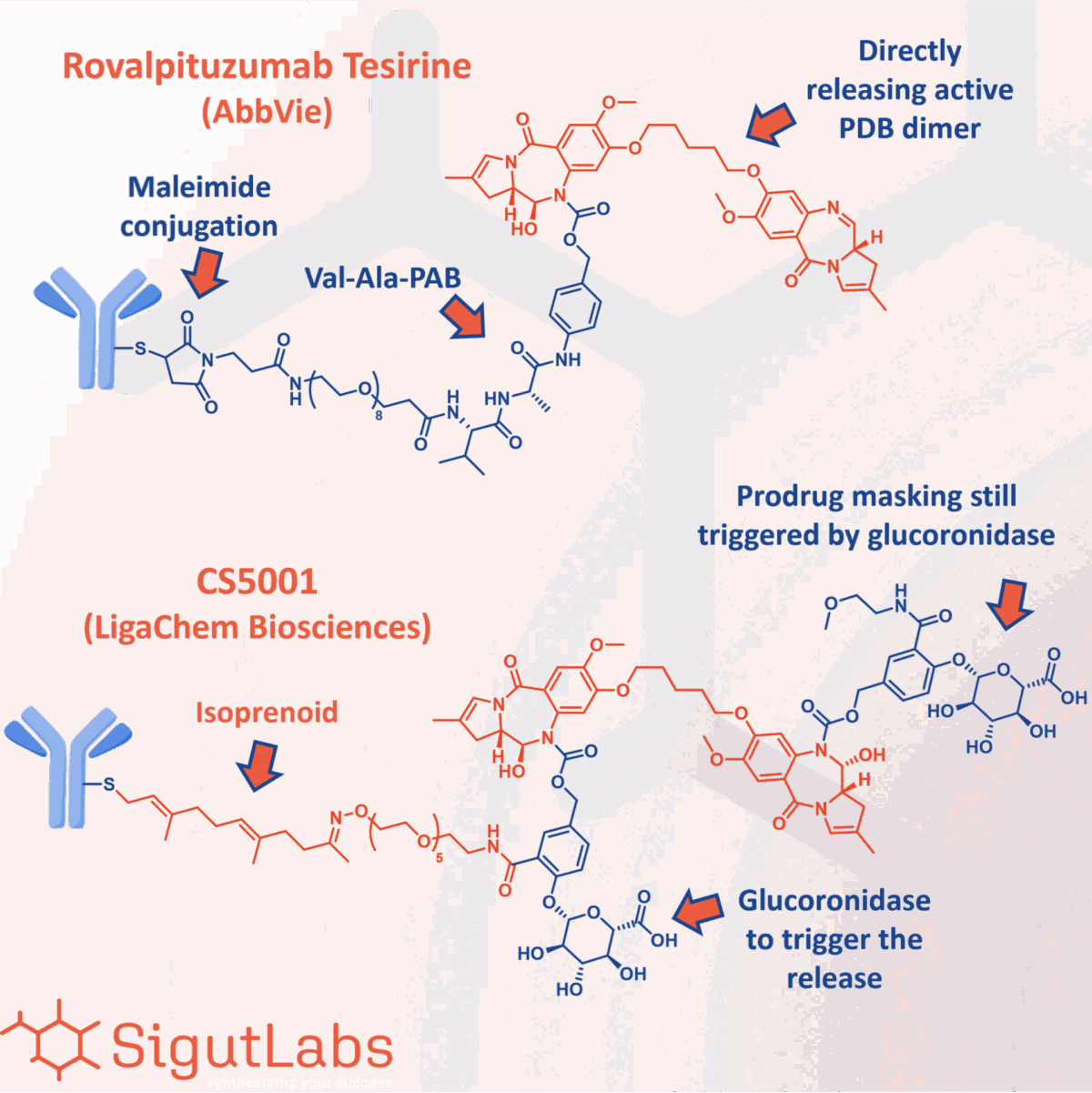
Many early PBD ADCs were built on the tesirine linker-payload construct — examples include rovalpituzumab tesirine (AbbVie) and camidanlumab tesirine (ADC Therapeutics). The majority of these clinical programmes were ultimately discontinued, most often because of dose-limiting, off-target toxicities.
Looking at the construct chemically, several structural features plausibly contributed to this outcome:
Delivery of a fully active payload. The tesirine construct releases an unmodified, fully DNA-reactive PBD dimer. There is no intermediate “off” state — whatever payload is liberated, wherever it is liberated, is immediately cytotoxic.
A conventional protease-cleavable linker. Tesirine relies on a valine-alanine (Val-Ala) dipeptide linker. While widely used, protease-cleavable dipeptides are not exclusively activated within the tumour, leaving room for release in unintended compartments.
Possible systemic exposure from linker instability. The maleimide-based conjugation chemistry is susceptible to the retro-Michael reaction, which can shed payload-linker species into circulation — a recognised contributor to off-target exposure in maleimide-conjugated ADCs.
Individually, none of these is fatal. Together, with a payload as unforgiving as a PBD dimer, they leave little margin for error.
A Structural Evolution: CS5001 (LCB71)
This is where the ROR1-targeting ADC CS5001 (also known as LCB71), developed by LigaChem Biosciences, becomes genuinely interesting. Currently in Phase I trials with improving safety and efficacy signals, it represents a deliberate structural redesign that addresses each weakness of the tesirine construct.
A β-glucuronide trigger instead of a dipeptide. CS5001 replaces the Val-Ala linker with a β-glucuronic acid trigger, cleaved by lysosomal β-glucuronidase — an enzyme highly expressed in the tumour environment. This shifts activation toward a more tumour-associated cue.
Prodrug masking of the payload. Crucially, the DNA-reactive imine of the PBD dimer is chemically masked with a self-immolative group. The circulating payload is therefore inactive — it only becomes cytotoxic after β-glucuronidase-triggered release unmasks it. This single design choice directly counters the tesirine construct’s “always-on” liability.
Site-specific conjugation. Rather than maleimide chemistry, LigaChem uses a site-specific method: a prenyltransferase attaches an isoprenoid handle, followed by oxime ligation to the linker. This yields a more homogeneous, more stable conjugate and sidesteps the retro-Michael instability associated with maleimides.
Why the Divergence Matters
The gap between the discontinued tesirine ADCs and the clinically active CS5001 programme is not a story about the payload — both deliver PBD dimers. It is a story about everything around the payload: how it is masked, how it is triggered, and how it is attached.
The lesson is one the ADC field keeps relearning. When the payload is exceptionally potent, the therapeutic window is defined almost entirely by control — control over where the payload is released, whether it is active in circulation, and how stable the conjugate remains in the bloodstream. Advanced linker and payload chemistry is not a refinement on top of a good ADC; it is what makes a potent payload usable at all.
How SigutLabs Can Help
As a dedicated chemistry CRO, SigutLabs provides exactly the kind of expertise this evolution demands:
- Synthesis of novel cleavable triggers, including enzyme-activated systems such as β-glucuronide linkers
- Development of prodrug masking and self-immolative strategies to render circulating payloads inactive
- Engineering of customised spacers and conjugation approaches to improve conjugate stability and performance
If you are working on PBD dimers, other high-potency payloads, or any aspect of ADC linker and payload chemistry, we would be glad to hear from you.

OUR CASE STUDY
Scale-up to accelerate drug discovery
Our experience helped overcome development hurdles for potential cancer & mental health drugs.
Read moreEmpowering neuro research with pro-N6pA
Sigut Labs scaled up pro-N6pA production, simplifying AMPylation research & boosting accessibility.
Read moreADC development leaps with new linkers
Novel linker design expedited ADC advancement, leading to promising lead compounds faster.
Read moreLincomycin derivative scale-up
Over 30 g of the desired product with exceptional purity was obtained through our optimized procedure.
Read morePurifying 350 kg of vitamin K2 oil
Our innovative scale-up technology helped to reduce the client’s purification process from days to hours.
Read moreOur services
What we excel in so you don’t have to
Custom synthesis
Providing for a custom synthesis of previously reported molecules using described synthetic procedures.
View more
Contract research
Developing novel synthetic routes to provide undescribed compounds in organic, bioorganic, and medicinal chemistry.
View more





Our Experts


Partners & distributors