From Academic Discovery to the Clinic: The Power of P5 Conjugation Chemistry
Antibody-drug conjugates have reshaped oncology, maturing into precision-guided therapeutics that deliver potent cytotoxic payloads directly to cancer cells. But building a stable, effective ADC remains a formidable engineering problem — and one of the hardest parts is something deceptively simple: how you attach the payload to the antibody in the first place.
The P5 conjugation platform is a striking example of how solving that single connection problem, with chemistry that began in academic labs, can ripple all the way into clinical trials.
The Problem With Maleimide
Traditional ADCs frequently rely on maleimide-based conjugation. It is widely used and well-established, but it carries several therapeutic bottlenecks that have constrained the field:
Retro-Michael instability and thiol exchange. Maleimide-thiol bonds can reverse in systemic circulation, allowing the payload to decouple from the antibody before it ever reaches the tumour.
Off-target toxicity. Premature payload release damages healthy tissues, narrowing the therapeutic window.
Aggregation and rapid clearance. Attaching hydrophobic payloads often causes the ADC to clump together, which leads to faster clearance from the body and poorer pharmacokinetics.
None of these is trivial, and together they cap what a maleimide-based ADC can achieve.
Enter the P5-Labeling Platform
The P5 conjugation handle offers a fundamentally more robust alternative. It is the product of decades of phosphorus chemistry — tracing back to the Staudinger-phosphite and phosphonite reactions, refined through the work of Karl T. Schuppe and Christian P. R. Hackenberger’s team — and it is built around an ethynylphosphonamidate core.
That core brings several decisive advantages to ADC design:
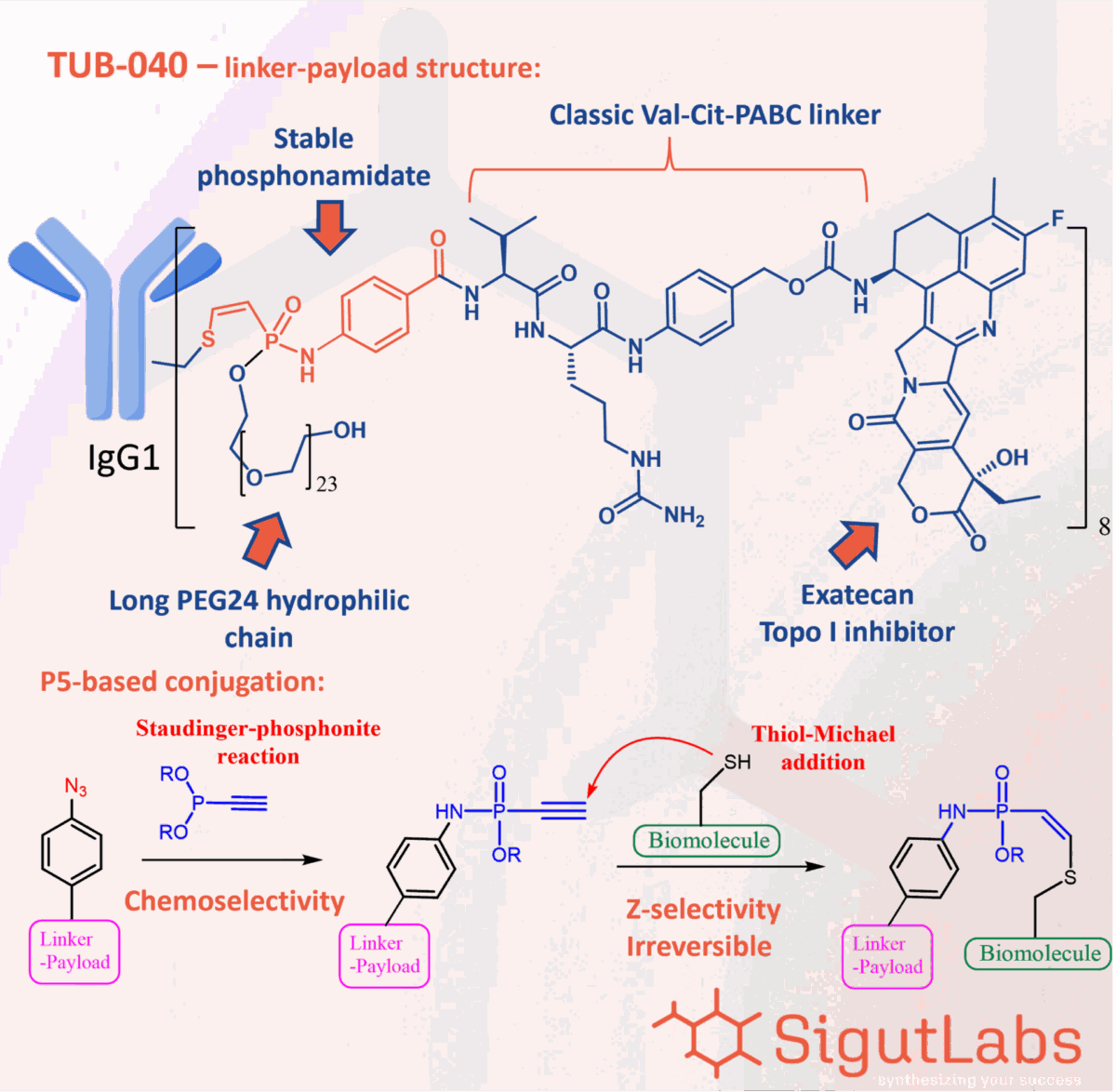
Ultra-high stability. The P5 handle shows excellent cysteine selectivity and forms an exceptionally robust linkage. Crucially, because it avoids retro-Michael reactions altogether, it eliminates the premature payload loss that plagues maleimide chemistry in circulation.
Simultaneous PEGylation. The chemistry allows a hydrophilic polyethylene glycol sidechain (such as PEG24) to be built directly into the P5 handle. The masking and the conjugation happen in one integrated step rather than as separate design problems.
Homogeneous DAR 8 ADCs. This built-in PEG shield counterbalances the hydrophobic nature of the payload, so the conjugate can carry a high drug-to-antibody ratio — exactly 8 payloads per antibody — without triggering aggregation. The result is a homogeneous conjugate with an excellent pharmacokinetic profile and maximised therapeutic potency.
The elegance here is integration: stability, hydrophilic masking, and high, uniform loading all emerge from a single conjugation strategy.
Moving Into the Clinic: TUB-030 and TUB-040
This is not purely academic chemistry. The spin-off company Tubulis has leveraged the P5 platform — within its broader Tubutecan linker-payload technology — to advance two ADC candidates into Phase I/IIa clinical trials, both delivering the topoisomerase I inhibitor exatecan at a homogeneous DAR of 8.
TUB-040 targets the NaPi2b antigen and is being developed for platinum-resistant ovarian cancer and lung adenocarcinoma.
TUB-030 targets the 5T4 antigen, which is expressed across a wide range of solid tumours.
The first clinical interim data for TUB-040 was presented in a late-breaking oral presentation at the ESMO Congress 2025 in Berlin. According to Tubulis, the candidate showed robust clinical activity with a favourable safety profile and good tolerability in heavily pre-treated, biomarker-unselected patients — the first clinical proof of concept for the underlying technology.
The Broader Lesson
The P5 story is a clean illustration of a pattern worth paying attention to: foundational chemical biology, developed over years in academic settings, becoming the enabling technology for a new generation of therapeutics. The connection between antibody and payload was never a minor detail — it was a bottleneck. Solving it with better chemistry unlocked everything downstream: stability, loading, pharmacokinetics, and ultimately clinical performance.
Translating smart chemistry into the clinic is exactly how the field moves toward safer, more effective cancer therapies.
How SigutLabs Can Help
This is the heart of what SigutLabs does. We specialise in the rational design and synthesis of advanced linker-payload systems, helping developers overcome the stability, conjugation, and efficacy challenges that define next-generation ADC programmes:
- Stable, site-selective conjugation chemistries beyond classical maleimide approaches
- Integrated PEGylation and hydrophilicity strategies to manage high-DAR aggregation
- Linker-payload design tuned for circulation stability and efficient release
If you are working to solve conjugation or stability challenges in an ADC programme, we would be glad to connect.

OUR CASE STUDY
Scale-up to accelerate drug discovery
Our experience helped overcome development hurdles for potential cancer & mental health drugs.
Read moreEmpowering neuro research with pro-N6pA
Sigut Labs scaled up pro-N6pA production, simplifying AMPylation research & boosting accessibility.
Read moreADC development leaps with new linkers
Novel linker design expedited ADC advancement, leading to promising lead compounds faster.
Read moreLincomycin derivative scale-up
Over 30 g of the desired product with exceptional purity was obtained through our optimized procedure.
Read morePurifying 350 kg of vitamin K2 oil
Our innovative scale-up technology helped to reduce the client’s purification process from days to hours.
Read moreOur services
What we excel in so you don’t have to
Custom synthesis
Providing for a custom synthesis of previously reported molecules using described synthetic procedures.
View more
Contract research
Developing novel synthetic routes to provide undescribed compounds in organic, bioorganic, and medicinal chemistry.
View more





Our Experts


Partners & distributors