Click Chemistry Enables ADCs for Heterogeneous Tumors
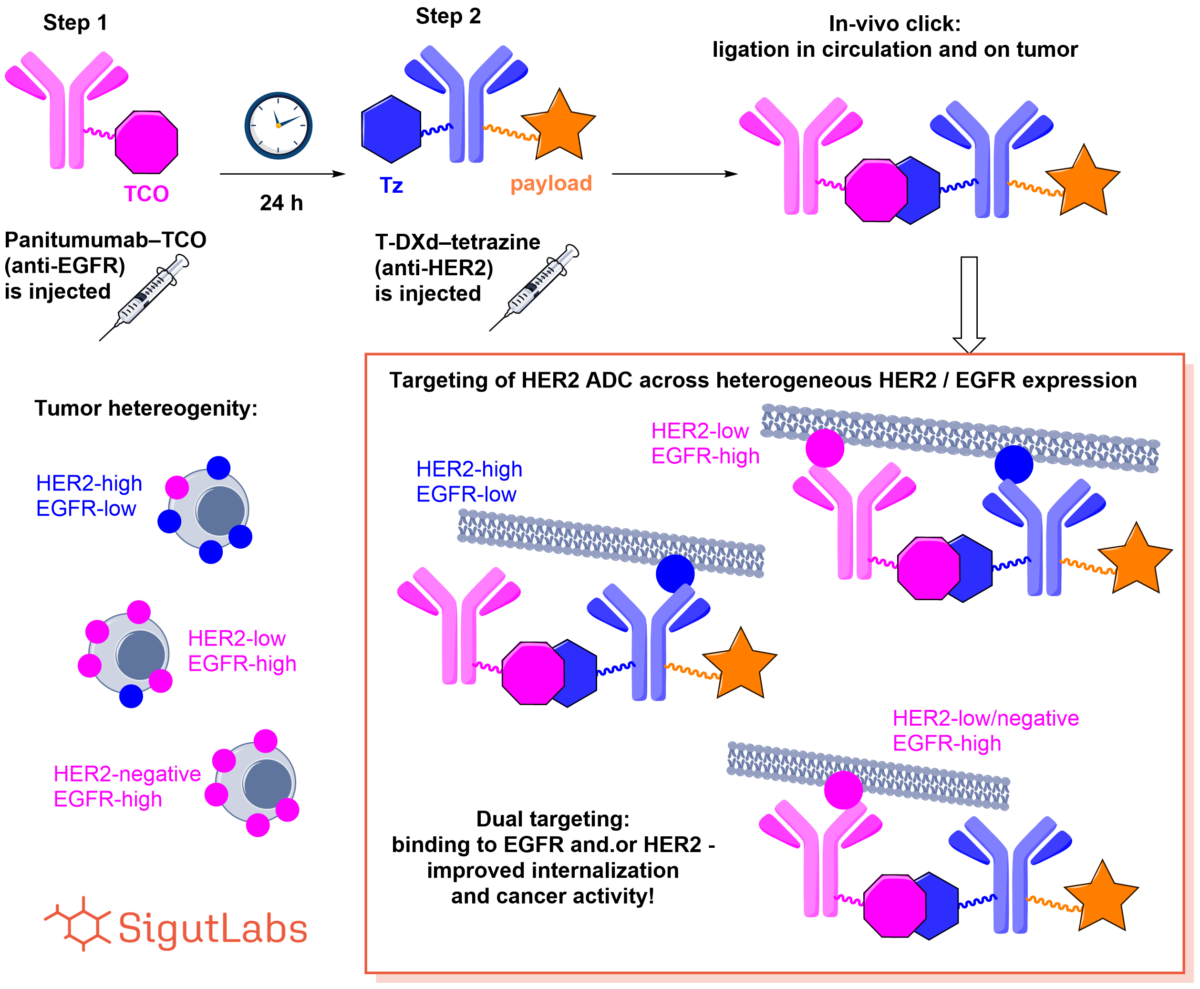
Conventional antibody-drug conjugates (ADCs) depend on uniform, high antigen expression to reach their target cells — a requirement that leaves highly heterogeneous or drug-resistant tumors largely refractory to targeted cell death. A recent study explores a chemical workaround to this fundamental limitation: by sequentially administering TCO- and tetrazine-modified antibodies, researchers were able to drive bioorthogonal ligation directly in vivo, successfully redirecting potent payloads like T-DXd into treatment-resistant, low-antigen cancer cells — without requiring complex multi-specific antibody engineering.
Take-Home Message
- Bioorthogonal ligation joined sequentially administered antibodies and ADCs directly in vivo, without extensive antibody re-engineering.
- EGFR co-targeting increased tumor uptake and lysosomal trafficking across HER2-low, ultralow, negative, and heterogeneous tumor models.
- The resulting “clicked” ADCs suppressed refractory tumors, prolonged survival, and restored therapeutic responses after resistance to conventional treatment had developed.
Why It Matters
This modular chemistry approach could effectively separate payload delivery from the requirement for uniform antigen expression, potentially extending the reach of ADC therapy to heterogeneous and treatment-refractory cancers that are currently difficult to address with conventional single-target constructs.
Open Questions
As promising as this approach is, several questions remain before it can move toward clinical application:
- How will receptor shedding and co-expression on normal tissue influence off-tumor ligation and associated toxicity?
- How does in vivo click efficiency translate within the dense stroma of human solid tumors, as opposed to preclinical models?
- What are the optimal pharmacokinetic dosing intervals for sequential administration, in order to minimize off-target systemic ligation?
SigutLabs’ Perspective
Bioorthogonal click strategies — including TCO/tetrazine chemistry — are part of the toolbox we work with directly in our antibody conjugation work, particularly where two-step conjugation is needed to avoid linker-payload incompatibility or self-reaction. Studies like this one reinforce why click-based conjugation chemistry is becoming an increasingly important lever in ADC design, not just for homogeneity and control, but potentially for reaching biology that conventional ADCs cannot.
If your program is exploring click-chemistry handles or site-specific conjugation strategies, contact us — we’re ready to support your project.
Reference: Simó, C., Vanover, A.C., D’Oliveira Albanus, R. et al. Modular in vivo antibody–ADC click to reverse drug resistance in tumours. Nature (2026).

OUR CASE STUDY
Scale-up to accelerate drug discovery
Our experience helped overcome development hurdles for potential cancer & mental health drugs.
Read moreEmpowering neuro research with pro-N6pA
Sigut Labs scaled up pro-N6pA production, simplifying AMPylation research & boosting accessibility.
Read moreADC development leaps with new linkers
Novel linker design expedited ADC advancement, leading to promising lead compounds faster.
Read moreLincomycin derivative scale-up
Over 30 g of the desired product with exceptional purity was obtained through our optimized procedure.
Read morePurifying 350 kg of vitamin K2 oil
Our innovative scale-up technology helped to reduce the client’s purification process from days to hours.
Read moreOur services
What we excel in so you don’t have to
Custom synthesis
Providing for a custom synthesis of previously reported molecules using described synthetic procedures.
View more
Contract research
Developing novel synthetic routes to provide undescribed compounds in organic, bioorganic, and medicinal chemistry.
View more





Our Experts


Partners & distributors