Antibody-Oligonucleotide Conjugates: Turning Antibodies into Precision Delivery Vehicles for RNA Therapeutics
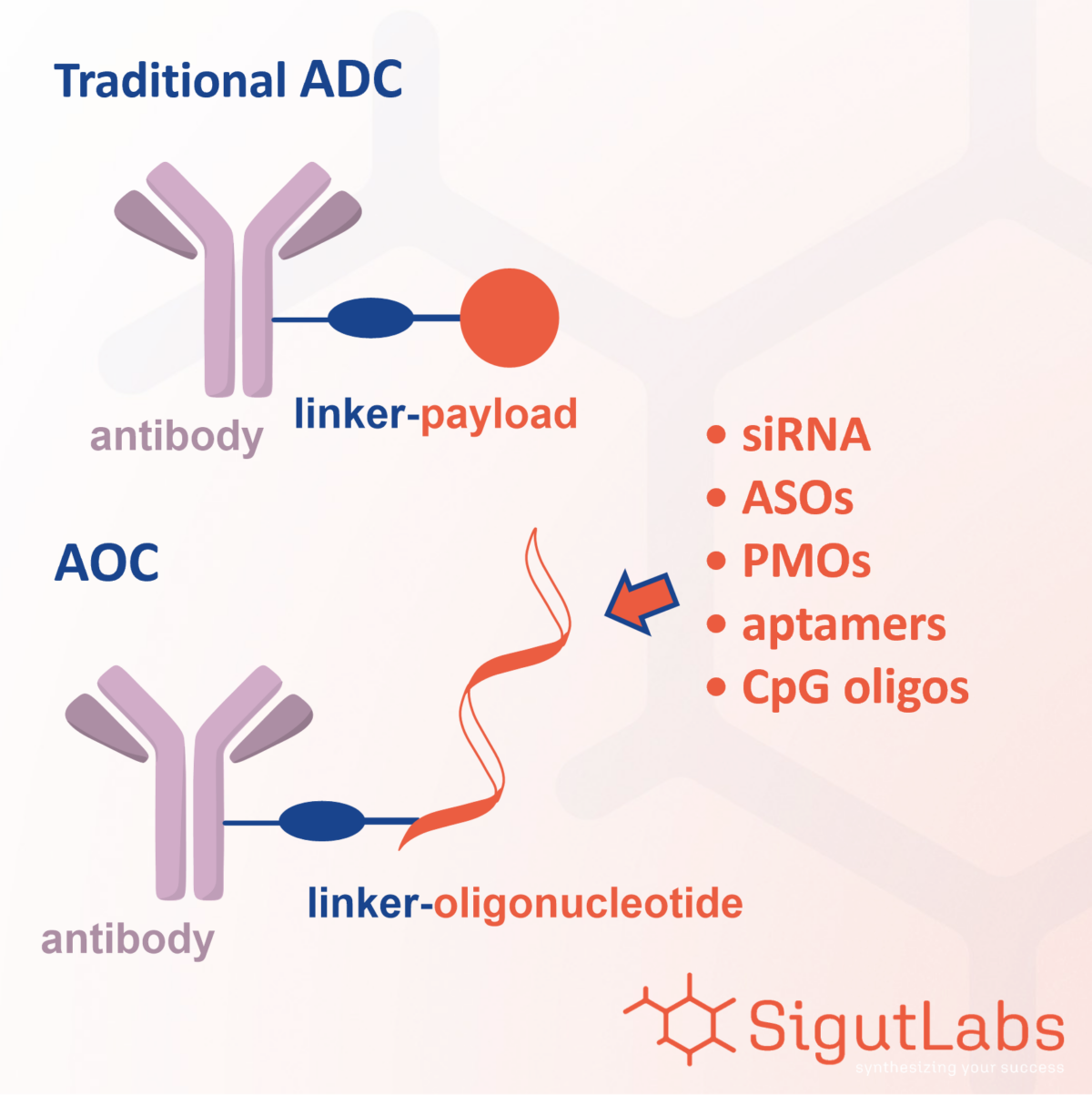
Oligonucleotide therapeutics carry enormous promise, but their clinical impact has long been limited by three recurring obstacles: poor tissue distribution, rapid systemic clearance, and inefficient intracellular delivery. Antibody-Oligonucleotide Conjugates (AOCs) are emerging as a compelling answer to these limitations, merging the tissue-targeting precision of monoclonal antibodies with the therapeutic power of RNA-based modalities.
In this post, we break down the key design considerations behind AOCs — target selection, payload diversity, and conjugation strategy — and look at how the field is translating into clinical progress.
Why Target Selection Is the First Design Decision
The choice of antibody target determines where the oligonucleotide payload ultimately ends up, making it the foundational decision in any AOC program. Receptors such as TfR1, HER2, and CD22 are being actively explored to route payloads toward skeletal muscle, tumor tissue, and even across the blood-brain barrier — tissues that have historically been difficult to reach with oligonucleotides alone.
A Growing Toolbox of Oligonucleotide Payloads
AOCs are compatible with a broad range of oligonucleotide modalities, each offering a different mechanism of action and therapeutic profile:
- siRNA
- Antisense oligonucleotides (ASOs)
- Phosphorodiamidate morpholino oligomers (PMOs)
- Aptamers
- Immune-stimulating CpG oligonucleotides
This modularity is part of what makes the AOC platform so versatile — the same targeting logic can, in principle, be paired with different payload classes depending on the therapeutic goal.
Conjugation Strategy: Moving Toward Site-Specific Control
How the payload is attached to the antibody is just as critical as what is being attached. The field is shifting away from stochastic conjugation methods and toward site-specific attachment strategies that offer tighter control over drug-to-antibody ratio (DAR), greater product homogeneity, and improved manufacturability — all essential for consistent clinical performance and scalable production.
Why Linker Chemistry Is Becoming a Key Differentiator
Unlike traditional antibody-drug conjugates (ADCs), AOCs must accommodate large, highly charged oligonucleotide payloads. This introduces distinct challenges for linker design, conjugation efficiency, in-circulation stability, and intracellular release kinetics.
Current approaches span both stable and cleavable linker chemistries — including disulfide-based and Val-Cit linkers — but no universal solution has emerged yet. The optimal linker architecture remains highly dependent on the specific biology and payload involved, which is exactly why linker design is increasingly seen as a key point of differentiation between AOC programs.
Clinical Momentum Is Building
AOCs are rapidly moving from a promising concept toward a clinically validated modality. Several programs illustrate this momentum:
- Avidity Biosciences has advanced del-desiran into Phase 3 following encouraging results in myotonic dystrophy type 1.
- Dyne Therapeutics continues to report promising dystrophin restoration with z-rostudirsen in Duchenne muscular dystrophy.
- Tallac Therapeutics is evaluating TAC-001, a CpG-TLR9 agonist conjugate, in oncology.
- Denali Therapeutics is leveraging its OTV platform to deliver oligonucleotides targeting MAPT in neurodegenerative disease.
What’s Next for the Field
Looking ahead, future innovation in AOCs will likely center on tighter control of DAR and conjugation sites, improved endosomal escape technologies, bispecific targeting strategies, and multi-payload oligonucleotide constructs.
How SigutLabs Supports AOC Development
At SigutLabs, we support companies developing next-generation AOCs through advanced linker chemistry and conjugation technology — from click-chemistry handles and site-specific attachment strategies to fully custom linker design for oligonucleotide conjugation.
If your program needs a partner for linker-payload chemistry, contact us — we’re ready to support your project.

OUR CASE STUDY
Scale-up to accelerate drug discovery
Our experience helped overcome development hurdles for potential cancer & mental health drugs.
Read moreEmpowering neuro research with pro-N6pA
Sigut Labs scaled up pro-N6pA production, simplifying AMPylation research & boosting accessibility.
Read moreADC development leaps with new linkers
Novel linker design expedited ADC advancement, leading to promising lead compounds faster.
Read moreLincomycin derivative scale-up
Over 30 g of the desired product with exceptional purity was obtained through our optimized procedure.
Read morePurifying 350 kg of vitamin K2 oil
Our innovative scale-up technology helped to reduce the client’s purification process from days to hours.
Read moreOur services
What we excel in so you don’t have to
Custom synthesis
Providing for a custom synthesis of previously reported molecules using described synthetic procedures.
View more
Contract research
Developing novel synthetic routes to provide undescribed compounds in organic, bioorganic, and medicinal chemistry.
View more





Our Experts


Partners & distributors