A Novel Payload, A Clever Junction: What Coibamide A Teaches Us About Linker-Payload Design
Coibamide A is a highly N-methylated cyclic depsipeptide derived from marine cyanobacteria. It works as a Sec61 inhibitor, blocking protein translocation into the endoplasmic reticulum and triggering apoptosis — a mechanism of action that remains rare among ADC payloads.
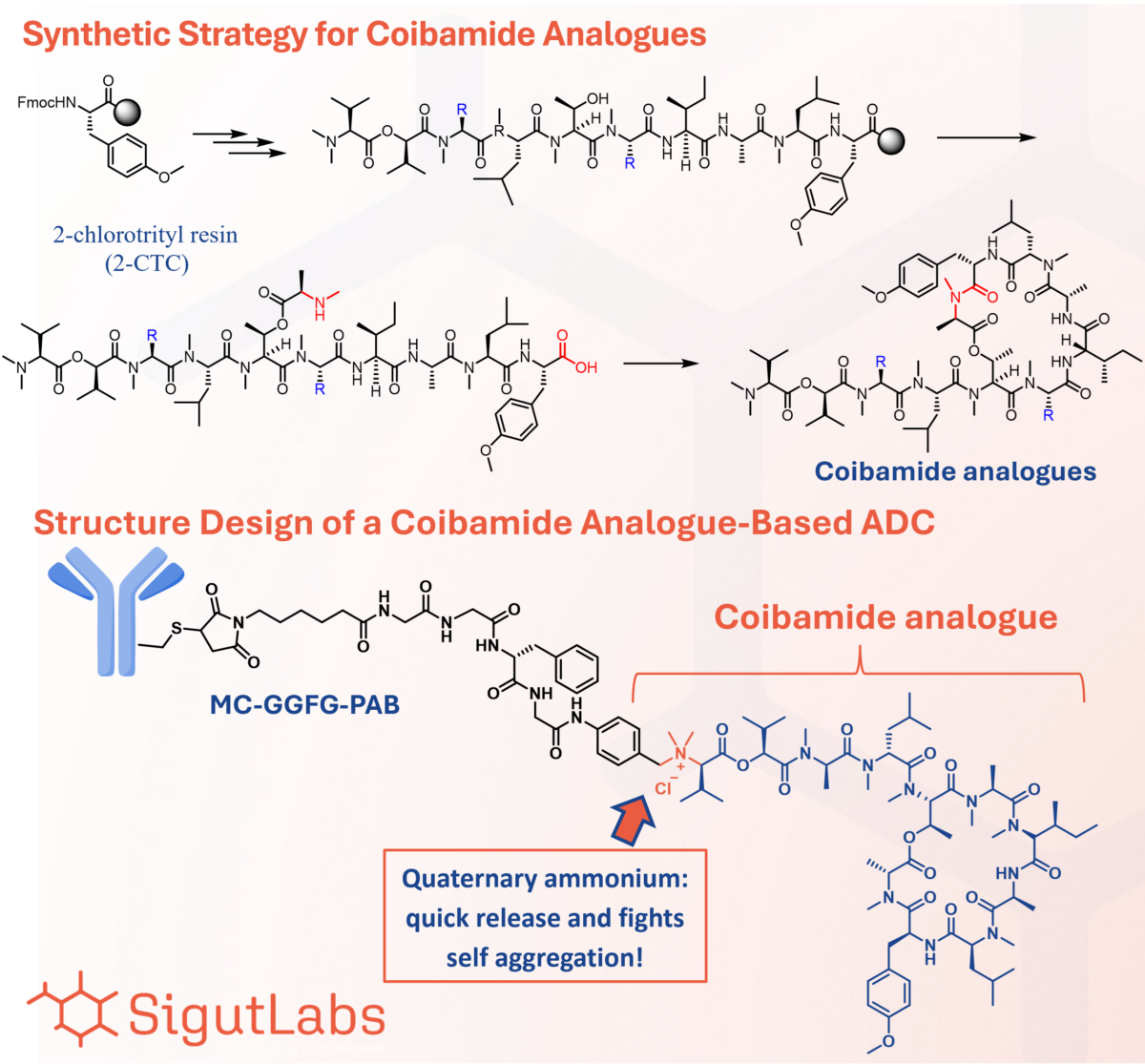
A recent paper reports an improved solid-phase synthesis of Coibamide A using 2-chlorotrityl resin, along with a set of 18 analogues generated to study structure-activity relationships. The best-performing analogue, [MeAla3-MeAla6]-coibamide, retained single-digit nanomolar potency (GI50 5.1-7.3 nM) across several cancer cell lines and showed lower toxicity than the natural compound in mice.
From Payload to ADC
The authors then built a full ADC: cetuximab (anti-EGFR) linked to this analogue through a cathepsin B-cleavable MC-GGFG-PAB linker. The resulting conjugate was active and target-specific both in vitro and in xenograft models, with a clear bystander killing effect. Notably, the same chemistry also worked with pertuzumab (anti-HER2), demonstrating that the platform isn’t tied to a single antibody.
The Detail That Caught Our Attention: The Linker-Payload Junction
What really stood out to us at SigutLabs is the chemistry at the linker-payload junction itself.
Normally, a PAB self-immolative unit is attached to a payload through a carbamate or an ester linkage. In this case, the payload’s own tertiary amine — its N,N-dimethyl backbone nitrogen — is directly alkylated by the PAB benzylic carbon, forming a quaternary ammonium salt right at the linker-payload junction.
This is a clever solution to a structural constraint: a tertiary amine has no N-H or O-H group available to build a conventional carbamate or ester linkage. Direct alkylation solves that problem. After cathepsin B cleaves the GGFG sequence, PAB self-immolation breaks the benzylic C-N bond and releases the payload as its native tertiary amine — traceless.
Why This Design Choice Is Smart
Beyond solving an attachment problem, this junction chemistry offers a secondary benefit: the permanent positive charge sits directly adjacent to a large, hydrophobic depsipeptide payload. Built-in charge like this is a well-established strategy against self-aggregation — a common failure mode for bulky, lipophilic payloads, particularly at high DAR.
SigutLabs’ Perspective
At SigutLabs, we design and synthesize custom ADC linkers and linker-payloads, including challenging self-immolative and charged architectures like the one described in this paper. Novel payload chemistries like Coibamide A analogues often demand equally novel linker chemistry to make them viable — exactly the kind of problem-solving we work on with our partners.
Need help with your next linker-payload design? Contact us — let’s connect.
Reference: Tian, H., Pan, W., Shi, H., Shao, X., Sun, J., Liang, J., … & Fang, L. (2026). Coibamide analogue as a novel-class payload for antibody-drug conjugate. Journal of Medicinal Chemistry, 69(5), 5691-5702.

OUR CASE STUDY
Scale-up to accelerate drug discovery
Our experience helped overcome development hurdles for potential cancer & mental health drugs.
Read moreEmpowering neuro research with pro-N6pA
Sigut Labs scaled up pro-N6pA production, simplifying AMPylation research & boosting accessibility.
Read moreADC development leaps with new linkers
Novel linker design expedited ADC advancement, leading to promising lead compounds faster.
Read moreLincomycin derivative scale-up
Over 30 g of the desired product with exceptional purity was obtained through our optimized procedure.
Read morePurifying 350 kg of vitamin K2 oil
Our innovative scale-up technology helped to reduce the client’s purification process from days to hours.
Read moreOur services
What we excel in so you don’t have to
Custom synthesis
Providing for a custom synthesis of previously reported molecules using described synthetic procedures.
View more
Contract research
Developing novel synthetic routes to provide undescribed compounds in organic, bioorganic, and medicinal chemistry.
View more





Our Experts


Partners & distributors