The Phosphorus Revolution: How Novel Chemistry Solved the ADC Stability Crisis
In the world of Antibody-Drug Conjugates (ADCs), the “perfect” molecule is often a victim of its own design. For years, the industry has wrestled with a frustrating trade-off: to make a drug more potent, you must add more payload, but adding more payload often makes the drug unstable and toxic.
It is rare to see a single chemical strategy solve two of the most notorious challenges in ADC design simultaneously. However, the development of TUB-040 (currently in Phase I by Tubulis) demonstrates exactly how phosphorus-based chemistry is rewriting the rulebook for stability and potency.
Fixing the “Payload Drop-off” Problem
Traditionally, the ADC industry has relied on maleimide chemistry to tether toxic payloads to antibodies. While effective at creating the bond, maleimide-based conjugates are notoriously susceptible to the retro-Michael reaction once they enter systemic circulation.
The result? The payload “drops off” prematurely in the bloodstream. This leads to a double failure:
Off-target toxicity: Healthy tissues are exposed to the free toxin.
Reduced efficacy: Less of the active drug actually reaches the tumor.
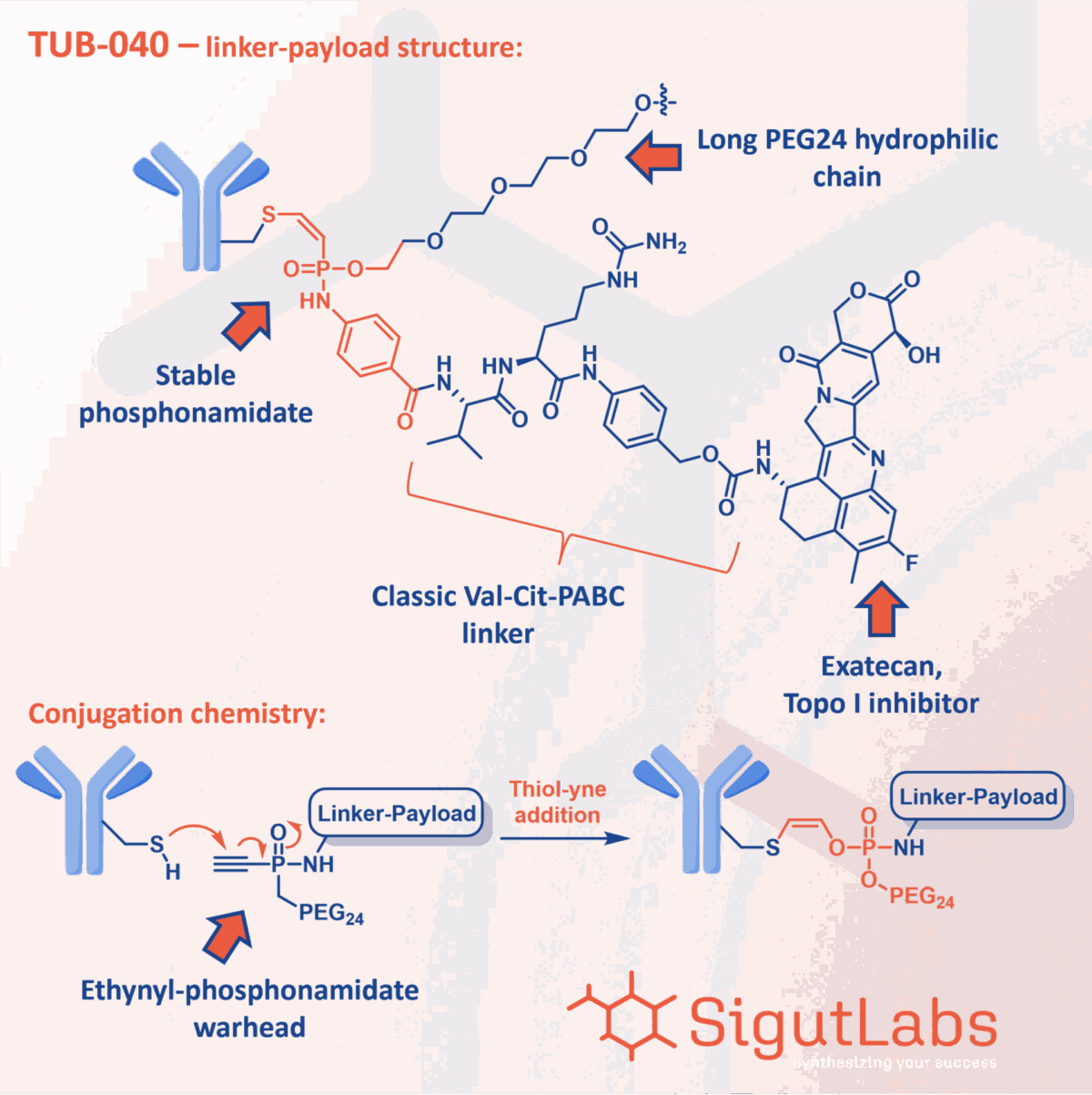
Tubulis sidestepped this entirely by substituting maleimide with a proprietary ethynyl-phosphonamidate group. Unlike traditional methods, this phosphorus-based chemistry forms an incredibly stable, irreversible bond with the antibody’s cysteine residues. This ensures the payload stays securely locked to the antibody until it is safely inside the cancer cell.
Breaking the Potency Ceiling: Stability at DAR 8
To maximize therapeutic impact, researchers often aim for a high Drug-to-Antibody Ratio (DAR). TUB-040 utilizes Exatecan, a highly effective Topoisomerase I inhibitor. However, Exatecan is also highly hydrophobic.
Packing eight of these “water-fearing” molecules onto a single antibody typically causes severe self-aggregation. In a clinical setting, this leads to rapid liver clearance and poor pharmacokinetics—the drug is essentially “cleared” before it can work.
The breakthrough in TUB-040 lies in the linker’s core architecture. By incorporating a PEG chain directly into the phosphonamidate core, the hydrophobicity of the payload is effectively masked. This results in:
High Loading: A potent DAR of 8.
Perfect Homogeneity: A uniform product rather than a messy mixture.
Enhanced Solubility: An ADC that remains stable in circulation without clumping or aggregating.
The Future of ADC Engineering
The success of candidates like TUB-040 highlights a shift in the industry: we are moving away from “standard” conjugation kits toward bespoke, highly engineered chemical solutions. When you fix the chemistry of the bond and the solubility of the linker, you unlock the true potential of the biological target.
At SigutLabs, we are dedicated to this level of precision. We support early-stage ADC innovation by designing and synthesizing custom linker and linker-payload architectures that solve the specific stability and solubility hurdles of your project.
Are you ready to move beyond traditional maleimide chemistry? Let’s connect and discuss how we can support your research with next-generation conjugation strategies.

OUR CASE STUDY
Scale-up to accelerate drug discovery
Our experience helped overcome development hurdles for potential cancer & mental health drugs.
Read moreEmpowering neuro research with pro-N6pA
Sigut Labs scaled up pro-N6pA production, simplifying AMPylation research & boosting accessibility.
Read moreADC development leaps with new linkers
Novel linker design expedited ADC advancement, leading to promising lead compounds faster.
Read moreLincomycin derivative scale-up
Over 30 g of the desired product with exceptional purity was obtained through our optimized procedure.
Read morePurifying 350 kg of vitamin K2 oil
Our innovative scale-up technology helped to reduce the client’s purification process from days to hours.
Read moreOur services
What we excel in so you don’t have to
Custom synthesis
Providing for a custom synthesis of previously reported molecules using described synthetic procedures.
View more
Contract research
Developing novel synthetic routes to provide undescribed compounds in organic, bioorganic, and medicinal chemistry.
View more





Our Experts


Partners & distributors