From Forest Floor to Clinical Trials: Solving the Chemistry of Amanitin-Based ADCs
At SigutLabs, we are fascinated by the intersection of natural product chemistry and precision medicine. One of the most compelling stories in modern drug development is the transformation of α-Amanitin—the lethal toxin found in the “Death Cap” mushroom—into a potent weapon against cancer.
While traditional Antibody-Drug Conjugates (ADCs) often rely on payloads that target cell division (microtubule inhibitors), α-Amanitin offers a distinct advantage: it binds to RNA Polymerase II, inhibiting cellular transcription. This unique mechanism allows it to eliminate not only rapidly dividing cells but also dormant cancer cells, effectively overcoming common pathways of drug resistance.
However, translating a macrocyclic toxin into a stable therapeutic is an immense chemical challenge. By examining the work of pioneers like Heidelberg Pharma (specifically their HDP-101 and HDP-102 programs), we can see how clever molecular engineering overcomes the hurdles of stability and toxicity.
The Three Pillars of Amanitin Engineering
Turning a toxin into a “magic bullet” requires solving three critical chemistry problems:
1. Payload Stabilization
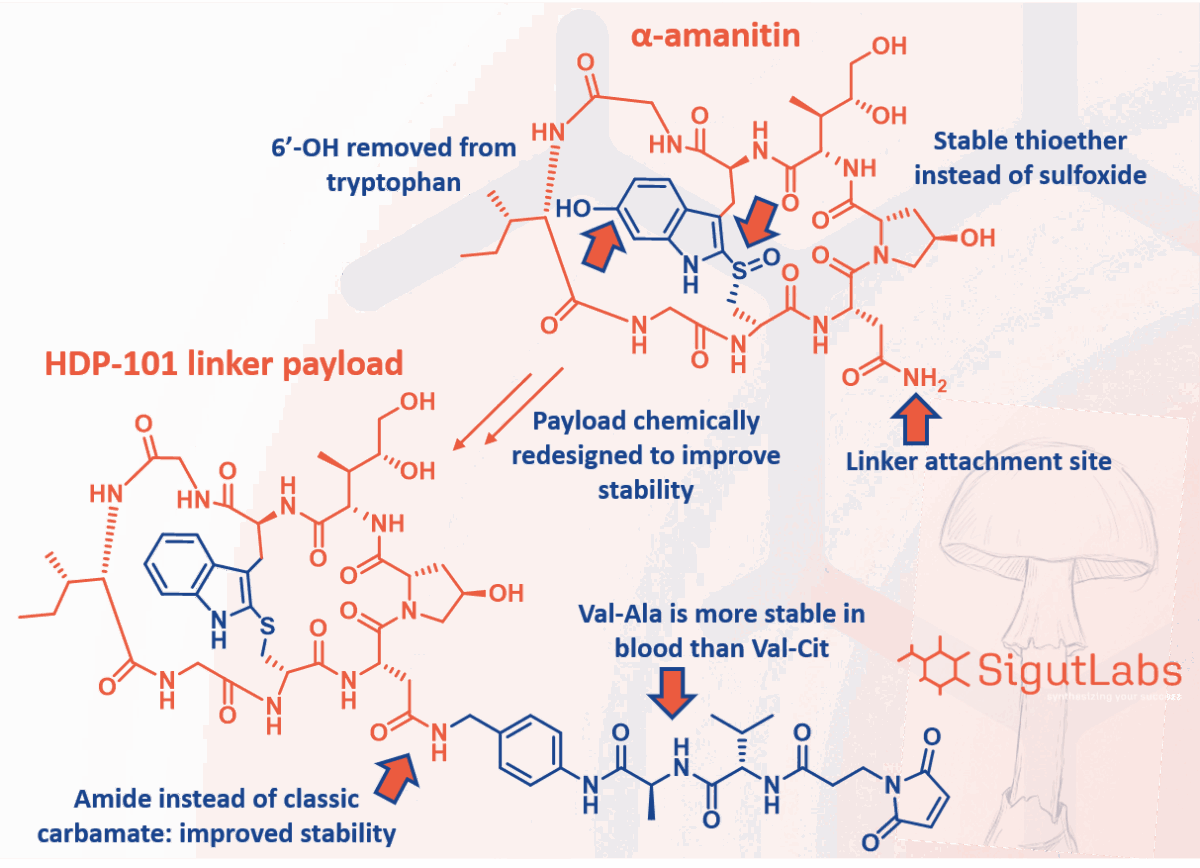
Natural α-Amanitin contains a delicate sulfoxide bridge and a reactive 6′-hydroxyl group. These features make the molecule prone to degradation during manufacturing and systemic circulation.
The SigutLabs Perspective: The solution lies in a complete synthetic redesign. By replacing the sulfoxide with a rugged thioether linkage and removing the reactive hydroxyl group, chemists create a stabilized payload that remains intact until it reaches its target.
2. Preventing Premature Release
Because amanitin is extremely hepatotoxic (toxic to the liver), any “leaky” release of the payload into the bloodstream is dangerous. While Valine-Citrulline (Val-Cit) linkers are industry standards, they can sometimes be prematurely cleaved by extracellular enzymes.
The Solution: A transition to Valine-Alanine (Val-Ala) dipeptide linkers paired with a self-immolative spacer. This combination provides superior stability in the blood but ensures rapid cleavage by Cathepsin B once the ADC is safely internalized within the tumor cell’s lysosome.
3. Precision Attachment
α-Amanitin is a complex structure; attaching a bulky linker to the wrong position can destroy its ability to bind to RNA Polymerase II.
The Solution: Precise site-specific attachment to the aspartic acid side-chain ensures the toxin’s binding interface remains perfectly intact, preserving its devastating potency against the tumor.
Driving ADC Innovation at SigutLabs
The journey of α-Amanitin highlights the central role of chemistry in the ADC revolution. At SigutLabs, we specialize in supporting early-stage innovation by designing and synthesizing the custom linker and linker-payload architectures that make these therapies possible.
Whether you are working with novel toxins or looking to optimize the stability of your current lead, our team is ready to help you solve your most complex chemistry challenges.
Interested in discussing the chemistry of your next ADC design? Contact us today at SigutLabs.

OUR CASE STUDY
Scale-up to accelerate drug discovery
Our experience helped overcome development hurdles for potential cancer & mental health drugs.
Read moreEmpowering neuro research with pro-N6pA
Sigut Labs scaled up pro-N6pA production, simplifying AMPylation research & boosting accessibility.
Read moreADC development leaps with new linkers
Novel linker design expedited ADC advancement, leading to promising lead compounds faster.
Read moreLincomycin derivative scale-up
Over 30 g of the desired product with exceptional purity was obtained through our optimized procedure.
Read morePurifying 350 kg of vitamin K2 oil
Our innovative scale-up technology helped to reduce the client’s purification process from days to hours.
Read moreOur services
What we excel in so you don’t have to
Custom synthesis
Providing for a custom synthesis of previously reported molecules using described synthetic procedures.
View more
Contract research
Developing novel synthetic routes to provide undescribed compounds in organic, bioorganic, and medicinal chemistry.
View more





Our Experts


Partners & distributors