Beyond Antibodies: How CBX-12 Reimagines Targeted Payload Delivery
Most conversations about targeted payload delivery centre on antibody-drug conjugates. But CBX-12 (alphalex™-exatecan) takes a structurally and mechanistically different route — one that is worth examining closely, because it offers useful insight into how peptide-drug conjugates (PDCs) are being optimised. Rather than relying on a monoclonal antibody and a specific surface antigen, CBX-12 targets tumours by exploiting their chemistry.
A Different Architecture
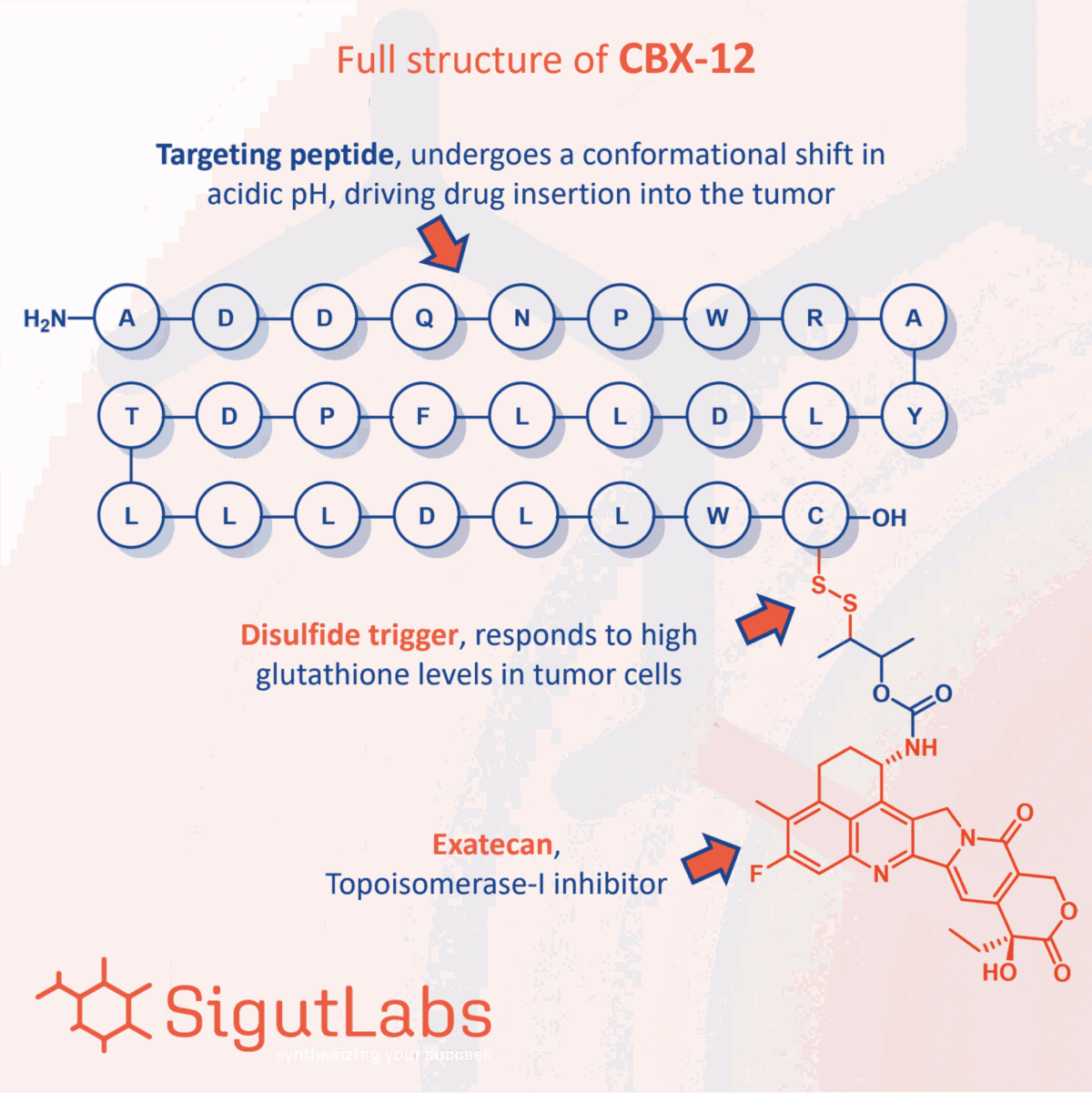
At its simplest, CBX-12 comprises three parts: a targeting peptide, a self-immolating linker, and the topoisomerase I inhibitor exatecan. What makes it distinct is the first component. Where a conventional ADC depends on the overexpression of a particular cell-surface antigen, CBX-12 uses an antigen-independent mechanism entirely.
The targeting moiety is a pH-Low Insertion Peptide (pHLIP). Its behaviour is governed by the acidity of its environment:
- In the neutral pH of healthy tissue, the peptide remains unstructured and does not insert into cell membranes.
- In the acidic microenvironment characteristic of solid tumours, it undergoes a thermodynamic conformational shift into a transmembrane alpha-helix.
That structural change drives the peptide directly into the lipid bilayer, translocating its C-terminus — and the attached payload — straight into the cytosol. The tumour’s own acidity becomes the targeting signal.
Why Swap an Antibody for a Peptide?
Replacing a bulky antibody with a small peptide brings several pharmacokinetic advantages:
Superior tumour penetration. The low molecular weight of the peptide allows rapid diffusion and better penetration into solid tumours than large antibodies can achieve.
Broader applicability. Because targeting does not depend on antigen binding, the approach extends to highly heterogeneous tumours and to patient populations that lack a specific biomarker for overexpression.
Favourable clearance and immunogenicity. PDCs tend to clear from the system faster and provoke less of an immune response than large protein biologics.
The Linker: Stable Outside, Triggered Inside
CBX-12 uses a glutathione-sensitive, self-immolating disulfide linker — a design that exploits the steep redox gradient between the extracellular and intracellular environments.
In the oxidative conditions of systemic circulation, the disulfide bond remains highly stable, preventing premature payload release in the bloodstream. Once the pHLIP has translocated the construct into the cytosol, the high intracellular concentration of glutathione rapidly reduces that disulfide bond. Cleavage then triggers a self-immolation cascade that efficiently releases the active, unmodified exatecan directly inside the cancer cell.
The result is a payload that stays caged until it reaches precisely where it is meant to act.
Rescuing a Toxic Payload
The strategic payoff of this design is what makes it compelling. Exatecan is a highly potent — and historically difficult — payload. By sequestering it within the conjugate and relying on pH-dependent cytosolic delivery, CBX-12 largely bypasses uptake in normal bone marrow and gastrointestinal tissue, the sites that typically drive dose-limiting toxicity.
Preclinical data established a therapeutic index of approximately 20-fold over unconjugated exatecan — effectively rescuing a payload that would otherwise be too toxic for practical clinical use.
The Broader Lesson
CBX-12 is a reminder that the “targeting” in targeted therapy does not have to mean an antibody and an antigen. A peptide that responds to the physical chemistry of the tumour microenvironment, paired with a linker tuned to the intracellular redox state, can achieve selective delivery through an entirely different logic. For heterogeneous tumours and biomarker-poor patient populations, that alternative logic may open doors that antigen-dependent approaches cannot.
It is, above all, a chemistry story: conformational switching, redox-triggered cleavage, and self-immolation working in sequence to turn a toxic molecule into a usable therapeutic.
How SigutLabs Can Help
Designs like this depend on precise linker-payload chemistry — exactly the work SigutLabs supports. We help advance early-stage innovation through:
- Custom design and synthesis of linkers and linker-payload constructs
- Redox- and pH-sensitive cleavable triggers, including self-immolating systems
- Payload conjugation strategies for both peptide- and antibody-based delivery platforms
If you are exploring novel targeted delivery approaches — whether PDC, ADC, or something less conventional — we would be glad to connect.

OUR CASE STUDY
Scale-up to accelerate drug discovery
Our experience helped overcome development hurdles for potential cancer & mental health drugs.
Read moreEmpowering neuro research with pro-N6pA
Sigut Labs scaled up pro-N6pA production, simplifying AMPylation research & boosting accessibility.
Read moreADC development leaps with new linkers
Novel linker design expedited ADC advancement, leading to promising lead compounds faster.
Read moreLincomycin derivative scale-up
Over 30 g of the desired product with exceptional purity was obtained through our optimized procedure.
Read morePurifying 350 kg of vitamin K2 oil
Our innovative scale-up technology helped to reduce the client’s purification process from days to hours.
Read moreOur services
What we excel in so you don’t have to
Custom synthesis
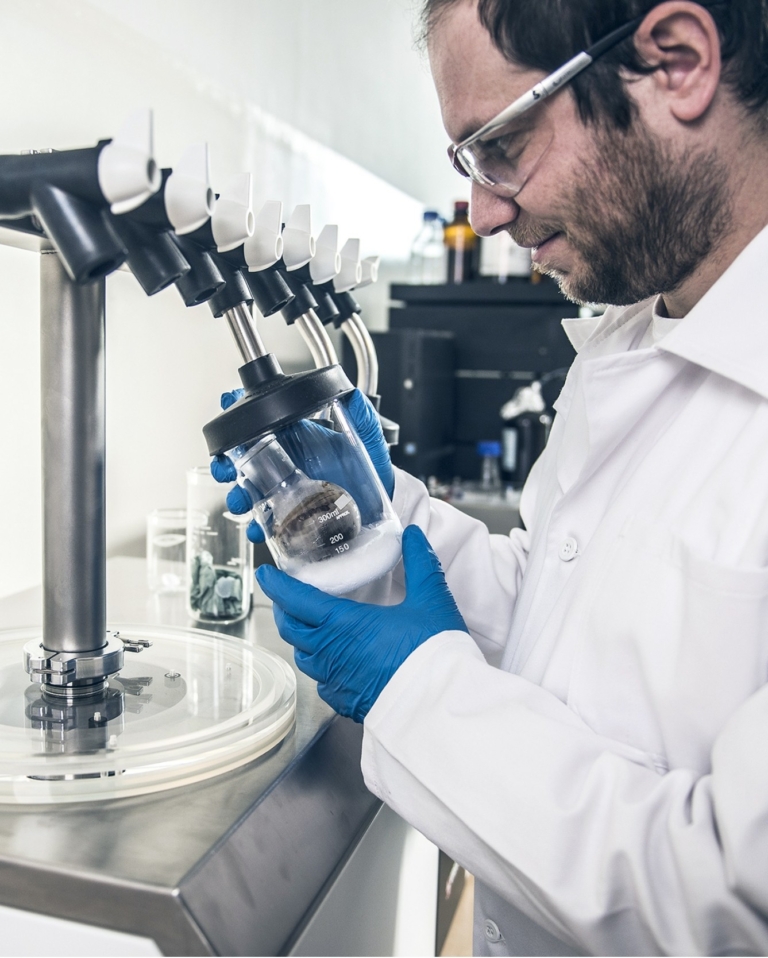
Providing for a custom synthesis of previously reported molecules using described synthetic procedures.
View more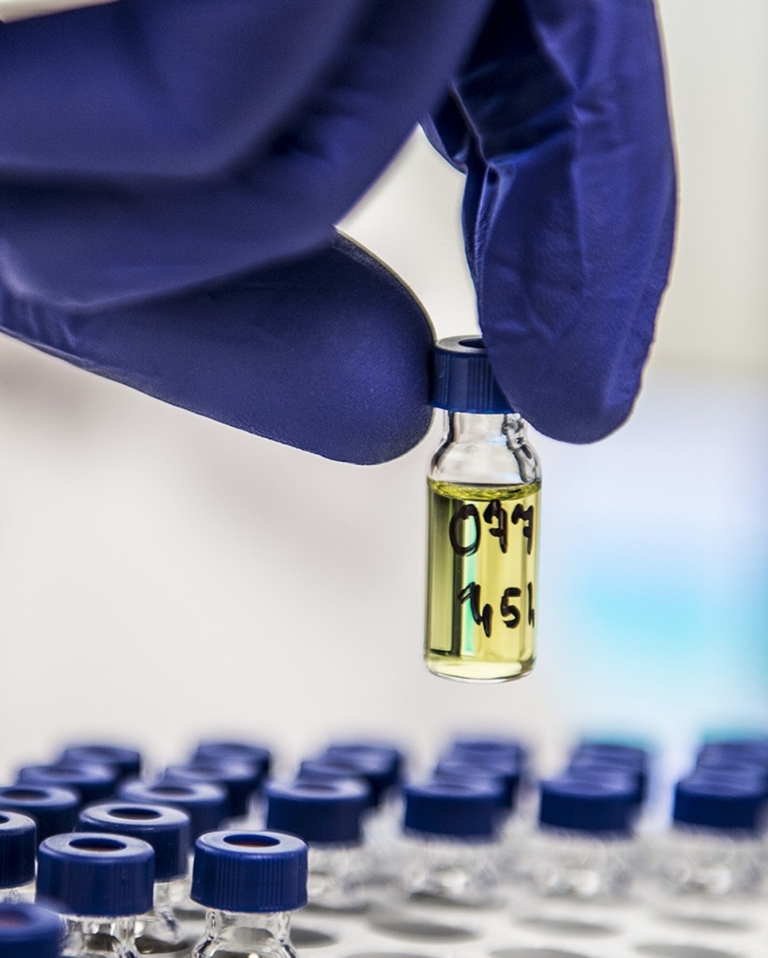
Contract research
Developing novel synthetic routes to provide undescribed compounds in organic, bioorganic, and medicinal chemistry.
View more





Our Experts


Partners & distributors